Insulation Contractors Langley

Attic Insulation Top Up in Langley BC: When to Do It, What It Costs, and What to Expect

Attic Insulation Top Up in Langley BC: When to Do It, What It Costs, and What to Expect

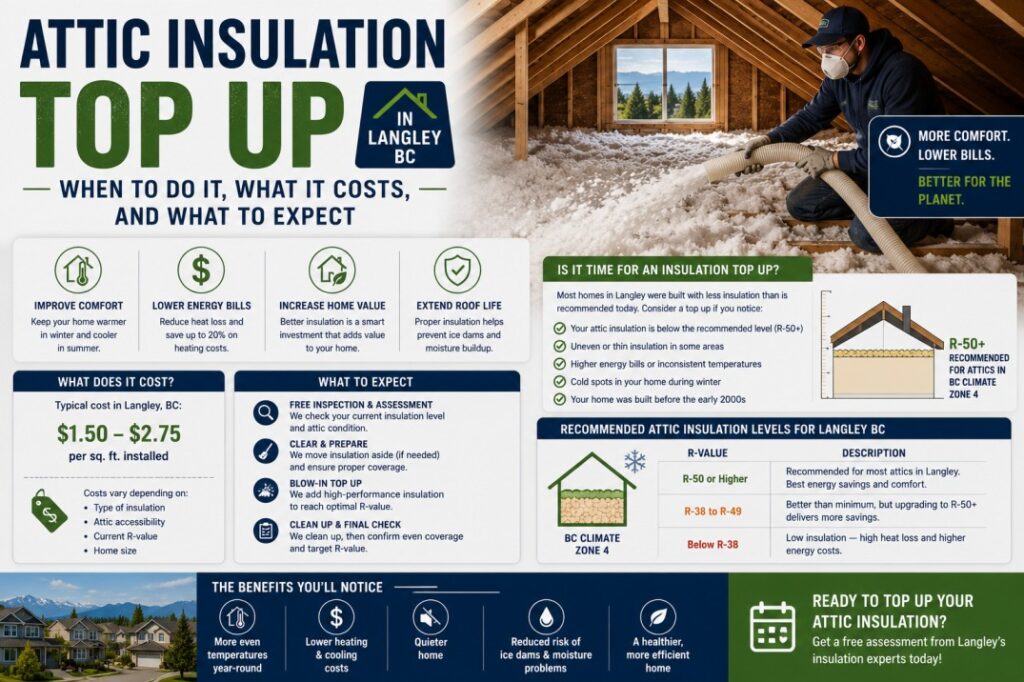
Attic Insulation Top Up in Langley BC: When to Do It, What It Costs, and What to Expect The short answer: An attic insulation top up is the right move when your existing insulation is structurally sound but below the R-50 to R-60 target recommended for Langley homes in BC Climate Zone 4. If your insulation is mold-contaminated, pest-damaged, or made from old compressed fibreglass, a full removal and replacement is the correct approach instead. Most Langley attic top-up projects cost $1,500 to $3,500 and qualify for BC Hydro and FortisBC rebates of up to $1,200. If you have been searching for information about topping up your attic insulation in Langley and finding answers that are either too vague or too US-focused to be useful, this guide is for you. It covers every question homeowners ask before booking an attic insulation top up — from how to know if topping up is right for your specific attic to exactly what the process looks like from start to finish. What Is an Attic Insulation Top Up? An attic insulation top up means adding new blown-in insulation on top of your existing attic insulation to increase the total R-value to the level your home needs. It is not a replacement — the existing insulation stays in place, and new material is blown in over it to build the total depth up to the target. This is the most common attic insulation project in Langley homes built between 1980 and 2010. These homes were typically insulated to the standard of the time — R-20 to R-32 — which was code-compliant when they were built but falls well short of what BC Building Code now requires and what experienced Langley insulation contractors recommend for real-world energy performance in the Fraser Valley climate. A properly executed top up brings the attic from wherever it currently sits to R-50, R-60, or beyond, depending on your goals and the BC rebate program you are targeting. And because existing insulation that is in good condition contributes to the final total, you are only paying for the additional material needed to reach the target — not a complete reinstall from scratch. Top Up vs Full Replacement: How to Know Which One You Need This is the question that matters most before any attic insulation project in Langley — and the answer depends on the condition of your existing insulation, not just its depth. A top up is the right choice when: Your existing insulation is dry, free of mold, and free of pest contamination. It may be compressed and settled below its original depth — that is normal for insulation of any age — but it is otherwise structurally sound and not a health or moisture risk. In this case, adding blown-in insulation on top of it is the most cost-effective path to R-50 or R-60, because the existing material still contributes meaningful R-value and does not need to come out first. Most Langley homes with fibreglass batts or blown-in fibreglass from the 1990s or early 2000s fall into this category, provided the home has not had a moisture problem, pest infestation, or roof leak that affected the attic space. A full removal and replacement is the right choice when: Your existing insulation is wet, mold-affected, or contaminated by rodents, squirrels, or other pests. Adding new blown-in on top of contaminated material does not fix the contamination — it buries it, and the underlying problem continues to develop. Our dedicated guide to attic insulation removal and replacement in Langley covers this process in full. Vermiculite insulation — a grey, granular material found in some pre-1990 Langley homes — may also need to be professionally assessed and in some cases removed before new insulation is installed, because it may contain asbestos. If you are unsure whether your existing attic insulation contains vermiculite, a professional inspection before any work proceeds is essential. The insulation removal service from Western Insulation handles all contaminated material safely, with industrial vacuum equipment, proper disposal, and a clean attic inspection before new blown-in insulation is installed. What Does an Attic Insulation Top Up Actually Involve? A professional attic insulation top up in Langley is not simply blowing more material in and calling it done. A properly executed top up includes several steps that determine whether the upgrade actually delivers the energy savings it is supposed to. Step 1 — Attic Inspection Before any material goes in, a trained inspector assesses your attic. This involves checking the existing insulation type and depth to determine your current R-value, identifying any moisture staining, mold, or pest evidence that would change the approach, locating and measuring air bypass locations — the gaps around light fixtures, plumbing penetrations, and wall top plates that allow warm air to escape from your living space into the attic — and confirming attic ventilation is functioning correctly. Step 2 — Air Sealing This is the step that separates a high-performing attic upgrade from a mediocre one — and it is the step most commonly skipped by less experienced contractors. Every air bypass location identified in the inspection is physically sealed using spray foam or acoustic sealant before any new insulation is installed. This matters because warm interior air escaping through those gaps bypasses the insulation entirely, reducing the real-world performance of your attic regardless of how much insulation sits above those gaps. Homes that receive air sealing alongside insulation upgrades achieve energy savings of 25 to 40% on heating costs. Homes that receive only additional insulation without air sealing typically achieve 10 to 15%. The difference is not the insulation material — it is whether the bypasses were closed first. This is why Western Insulation includes air sealing as a standard component of every attic insulation project in Langley. Step 3 — Blown-In Insulation Installation Once air sealing is complete, blown-in fibreglass insulation — typically ProPink by Owens Corning — is machine-applied over the existing insulation to the target depth. ProPink is a GREENGUARD

Attic Insulation Top Up in Langley BC: When to Do It, What It Costs, and What to Expect Read More »
BC Energy Step Code Insulation Guide for Langley BC | 2026

BC Energy Step Code and Insulation: What Langley Homeowners and Builders Need to Know

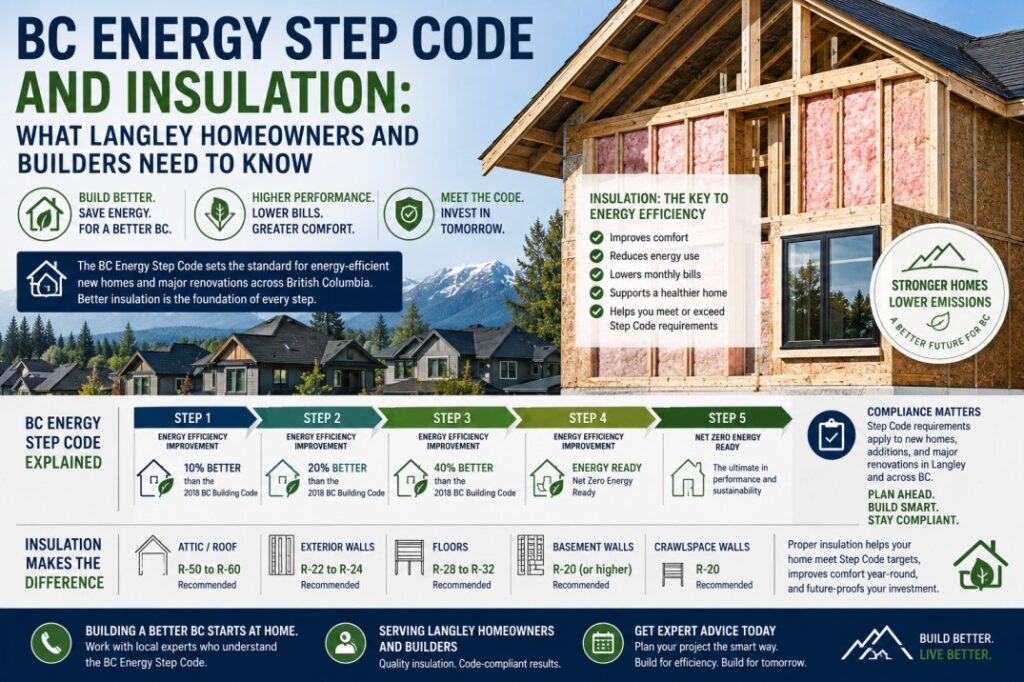
BC Energy Step Code and Insulation: What Langley Homeowners and Builders Need to Know The short answer: The Township of Langley requires Step 4 under the BC Energy Step Code for all new Part 9 residential construction as of April 1, 2025. This means new Langley homes must meet significantly higher insulation, airtightness, and energy performance standards than the previous minimum BC Building Code required — and it affects how insulation is specified, installed, and documented on every new build and major renovation in the municipality. If you are building a new home in Langley, planning a significant renovation, or simply trying to understand why insulation requirements seem to have changed since you last dealt with them, this guide explains the BC Energy Step Code in plain language — what it requires, what it means for insulation specifically, and why it matters for existing homeowners as well as new builders. What Is the BC Energy Step Code? The BC Energy Step Code is a tiered performance standard that sets progressively higher energy efficiency requirements for new residential and commercial construction in British Columbia. Unlike the previous BC Building Code approach — which set minimum requirements for individual building elements like insulation R-values, window performance, and heating systems — the Step Code sets a whole-building energy performance outcome and allows builders to decide how to achieve it through the combination of materials and design choices that best fits their project. The Step Code is organised in numbered steps, with Step 1 being the baseline minimum and Step 5 representing near-net-zero energy performance. Steps require a pre-construction energy model developed by a registered Energy Advisor, a mid-construction blower door airtightness test before drywall is installed, and a final as-built compliance report confirming the home performs as designed. In practical terms, higher Steps require better insulation, better airtightness, better windows, and better mechanical systems — and insulation is the component of the building envelope where achieving Step compliance most often requires deliberate planning and the right contractor. What Step Does Langley Require in 2026? The Township of Langley requires Step 4 and Zero Carbon EL-3 for all new Part 9 residential construction — a category that covers most single-family homes and small multi-family buildings — for building permits submitted from April 1, 2025 onward. This is one of the more demanding Step Code requirements in Metro Vancouver and the Fraser Valley, placing Langley alongside municipalities like Vancouver, Richmond, and Burnaby in requiring performance well above the provincial baseline. Step 4 in the BC Energy Step Code requires an airtightness target of 1.5 air changes per hour or better, measured by a blower door test. Achieving that level of airtightness in a real building is not possible through insulation alone — it requires a coordinated air barrier strategy where every penetration, joint, and transition in the building envelope is deliberately sealed. Insulation and airtightness work together in a Step 4 home: the insulation provides the thermal resistance, and the air barrier prevents warm air from bypassing that resistance through convective movement. For comparison, the City of Surrey requires Step 3 (2.5 air changes per hour airtightness target), and Abbotsford requires Step 3 with EL-1 for permits after March 2025. The Township of Langley’s Step 4 requirement is a meaningful step up from these surrounding municipalities. What Does Step 4 Mean for Insulation in a Langley New Build? Step 4 does not prescribe specific R-values for each zone of a new Langley home — it sets a whole-building energy performance outcome that the design team must model and achieve. However, there are practical insulation specifications that are well-established as the typical approach for achieving Step 4 compliance in Langley’s Climate Zone 4 conditions. Attic and Roof Assembly To achieve Step 4 energy performance in Langley, attic insulation in new residential construction typically needs to reach R-50 to R-60 minimum — with many Step 4-compliant designs targeting R-60 or higher. The ceiling or attic floor assembly must be designed as part of the overall air barrier strategy, with every penetration sealed before insulation is installed. For standard vented attic designs in Langley new builds, blown-in fibreglass insulation is the most practical method for achieving R-50 to R-60 consistently across the full attic floor. For unvented roof assemblies — where the insulation is applied to the underside of the roof decking rather than the attic floor — spray foam insulation is the typical choice, as it provides both the required R-value and the continuous air barrier without a separate air barrier product. Exterior Walls Achieving Step 4 energy performance in Langley exterior walls requires exceeding the standard prescriptive minimum. In practice, this typically means either 2×6 framing with R-22 cavity insulation plus a layer of continuous rigid foam insulation on the exterior, or a similar combination that brings the effective wall R-value above R-22 while eliminating thermal bridging through the framing. Thermal bridging — the phenomenon where heat conducts through structural framing members, bypassing the cavity insulation — is a significant factor in Step 4 compliance. A 2×6 wall with R-22 batt insulation in the cavity performs at approximately effective R-16 when thermal bridging is accounted for. Adding a layer of continuous rigid foam on the exterior breaks the thermal bridge and brings the whole-wall effective R-value up to where Step 4 energy modelling requires it. Basement and Foundation Walls In new Langley construction targeting Step 4, basement and foundation walls typically require R-20 or higher in an effective, thermally continuous assembly. Closed-cell spray foam applied directly to foundation walls combined with continuous rigid foam is a common approach — providing both the required R-value and the vapour control needed in BC’s damp climate. The full scope of what Western Insulation provides for basement and crawlspace insulation covers both new construction and retrofit applications. Airtightness and Air Sealing Step 4’s 1.5 air changes per hour airtightness target is where many Langley new builds either succeed or fall short — and it is the element most directly

BC Energy Step Code and Insulation: What Langley Homeowners and Builders Need to Know Read More »

How Much Does Home Insulation Save on Energy Bills in Langley BC?

How Much Does Home Insulation Save on Energy Bills in Langley BC?

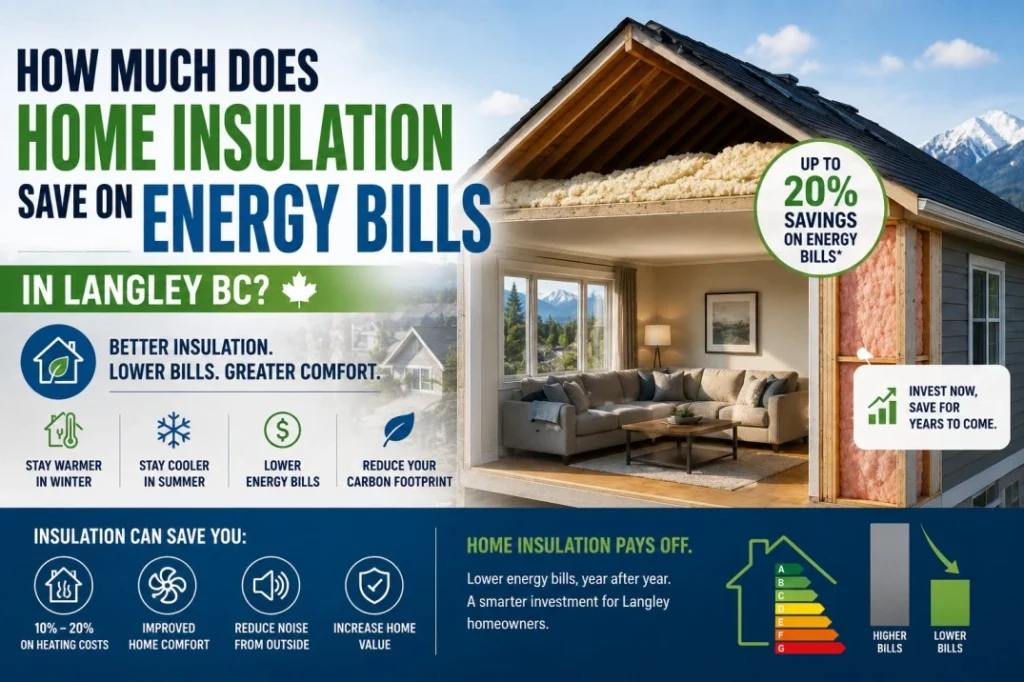
How Much Does Home Insulation Save on Energy Bills in Langley BC? The short answer: a properly insulated Langley home saves between 10% and 30% on annual heating and cooling costs, with most whole-home upgrades delivering payback within three to five years — and up to $5,500 in BC rebates reducing the upfront investment significantly. But the short answer only tells part of the story. The amount you save depends on which part of your home is insulated, what material is used, how well it is installed, and how under-insulated your home was to begin with. A Langley home that has never had its crawlspace or walls insulated will see far greater savings than one where only an attic top-up is needed. This guide breaks it down clearly — zone by zone, number by number — so you know exactly what to expect before you book a single assessment. Why Energy Savings From Insulation Are Higher in Langley Than Most Canadians Expect Langley sits in BC Climate Zone 4 — a climate defined by sustained damp cold in winter, significant temperature swings between seasons, and a heating season that runs from October through April. Unlike prairie cities where extreme cold dominates, Langley’s challenge is the persistence of cool, wet conditions that put constant pressure on your home’s building envelope. This persistent pressure means heat loss in an under-insulated Langley home is not occasional — it is continuous. Your furnace or heat pump is compensating for that loss every hour of every day during the heating season. The cumulative energy cost of that compensation is what proper insulation eliminates — and in BC, heating and cooling account for approximately 60 to 65% of a typical household’s total energy bill. According to BC Hydro and FortisBC program data, typical homeowners save at least 10% on their home’s energy costs after an insulation upgrade. Western Insulation’s own project data across more than 2,400 completed homes in the Fraser Valley puts the average savings from a full attic and crawlspace upgrade at 20 to 30% — a figure consistent with Natural Resources Canada research on whole-home insulation performance. Energy Savings by Zone: Where Insulation Delivers the Most Impact Different parts of your home lose heat at different rates — and understanding which zones deliver the highest return helps you prioritise your investment. Attic Insulation: The Highest Single Impact The attic is the single largest source of heat loss in a typical Langley home. Heat rises naturally, and without sufficient R-value above the ceiling plane, it escapes continuously through the roof — regardless of what the rest of your home’s envelope looks like. Expected savings: 15 to 25% reduction in heating costs for homes moving from R-20 or below to R-50 or R-60. Most Langley homes built before 2000 have attic insulation sitting between R-12 and R-30 — well below the current BC Building Code minimum of R-40 to R-50 and the R-60 that our attic insulation service in Langley BC targets for optimal Fraser Valley performance. The gap between what these homes have and what they need is measured directly in monthly energy costs. A household spending $250 per month on heating with an attic at R-20 that upgrades to R-60 can expect to reduce that specific portion of heat loss by 25 to 40%, depending on ceiling area and construction. For a 1,200 square foot attic floor, this translates to a meaningful and measurable reduction in monthly bills — one that accumulates month after month through every heating season for the 25 to 30-year life of the insulation. Crawlspace Insulation: The Most Underestimated Saving Poorly insulated walls, attics, or basements can cause up to 40% of a home’s total heat loss — forcing your heating and cooling systems to work harder than they should. The crawlspace’s contribution to that figure is consistently underestimated because it is invisible — Langley homeowners do not see the cold air entering through uninsulated floor joists the way they feel a draft from a window. Expected savings: 10 to 15% reduction in total home heating costs for homes with previously uninsulated crawlspaces. Cold floors above an uninsulated crawlspace are one of the most consistent complaints from Langley homeowners in older homes — and they are a direct expression of the energy loss happening beneath your feet. Our crawlspace and basement insulation service for Langley homes uses closed-cell spray foam and a heavy-duty vapour barrier to address both the thermal loss and the moisture conditions that compound the energy problem in BC’s damp climate. Wall Insulation: The Largest Surface Area, The Biggest Opportunity Exterior walls represent the largest surface area of your home’s building envelope — and in a Langley home built before 1995, those walls are almost certainly under-insulated relative to current BC standards. Empty or minimally insulated 2×4 wall cavities perform at R-8 or below in real-world conditions, against a BC code requirement of effective R-22 to R-24. Expected savings: 10 to 20% reduction in total energy costs for homes with empty or near-empty wall cavities that are brought to full density. Our wall insulation retrofit guide for existing Langley homes explains how dense-pack blown-in insulation through small access holes — without drywall removal — brings those cavities to R-13 to R-22 depending on framing depth. This is the most underutilised energy upgrade available to existing Langley homes, and it is one where the absence of local competitor content means homeowners frequently do not realise it is an option without demolition. Whole-Home Insulation: Where the Numbers Compound The most significant energy savings come when attic, crawlspace, and wall insulation are addressed as a coordinated system. Heat loss pathways are interconnected — plugging one without addressing others delivers partial results. Expected savings for a whole-home upgrade across all zones: 20 to 30% reduction in total annual energy costs. For a Langley household with a combined heating and cooling bill of $3,000 per year, a 25% reduction represents $750 in annual savings — every year, for the life

How Much Does Home Insulation Save on Energy Bills in Langley BC? Read More »

Batt Insulation in Langley BC: Is It the Right Choice for Your Home?

Batt Insulation in Langley BC: Is It the Right Choice for Your Home?

Batt Insulation in Langley BC: Is It the Right Choice for Your Home? Walk into any building supply store in Langley and batt insulation is impossible to miss. Stacked in rolls and pre-cut sections along entire aisles, it is the most visible, most familiar, and most widely recognised insulation product available — and for good reason. Batt insulation has been the standard choice for Canadian residential construction for decades, and it remains one of the most practical and cost-effective options available today. But familiarity can create confusion. Is batt insulation always the right choice? Where does it perform best and where does it fall short? What is the difference between fibreglass batts and mineral wool batts — and does it matter for a Langley home? And when should you choose blown-in or spray foam instead? This guide answers every one of those questions clearly, so Langley homeowners can make a confident, informed decision before any insulation project begins. What Is Batt Insulation and How Does It Work? Batt insulation is a pre-formed, flexible insulation product manufactured in panels or rolls sized to fit standard stud and joist spacing — typically 16 inches or 24 inches on centre. It is installed by pressing or cutting the batt to fit snugly between framing members, where it works by trapping millions of tiny air pockets within its fibrous structure, slowing the transfer of heat through the wall, floor, or ceiling assembly. The two most common types used in Langley residential construction are fibreglass batts and mineral wool (rock wool) batts. Both work on the same principle but differ significantly in performance characteristics, and understanding those differences is essential to choosing the right product for your specific application. Fibreglass Batts vs Mineral Wool Batts: What Langley Homeowners Need to Know Fibreglass Batt Insulation Fibreglass batts are made from spun glass fibres and have been the dominant residential insulation product in Canada for over 50 years. They are lightweight, widely available, non-combustible, and available in a range of R-values from R-12 (for 2×4 walls) up to R-22 and beyond (for 2×6 framing). They are also the most budget-friendly batt option, which is why they remain the standard in new construction across Langley and the Fraser Valley. Properly installed — cut accurately, fitted snugly without compression, and combined with thorough air sealing — fibreglass batts deliver reliable, consistent thermal performance. The critical word is properly. Fibreglass batts are more sensitive to installation quality than almost any other insulation product. A compressed batt, a gap around an electrical box, or a poorly fitted section at a joist can reduce the real-world performance of a fibreglass wall assembly significantly. This is one reason Western Insulation recommends professional installation for any project where thermal performance is the primary goal. One important characteristic of fibreglass batts in Langley’s climate: they absorb moisture when wet. In a well-constructed wall assembly with appropriate vapour control, this is not a problem. But in a crawlspace, an area with known moisture issues, or any application where the batt is directly exposed to damp conditions, fibreglass degrades and loses R-value over time. For those applications, our spray foam or rigid foam services are the more appropriate choice. Mineral Wool (Rock Wool) Batts Mineral wool batts — often sold under brand names like Rockwool Comfortbatt — are made from spun volcanic rock and industrial slag. They are denser, heavier, and more rigid than fibreglass, and they offer several performance advantages that make them the preferred choice in specific applications. Mineral wool is naturally water-repellent. Unlike fibreglass, it does not absorb or hold moisture, which makes it more resilient in BC’s damp climate and a strong choice for exterior wall assemblies. It is also non-combustible to a significantly higher temperature than fibreglass — an important consideration for fire-rated wall assemblies in strata buildings or secondary suites. The acoustic performance of mineral wool is where it truly stands out. Because it is denser than fibreglass, it absorbs sound waves more effectively across a wider frequency range. When Langley homeowners are insulating interior walls between suites, bedrooms, or home offices, mineral wool batts deliver noticeably better noise reduction than fibreglass in the same wall cavity. For a full discussion of acoustic insulation for Langley homes, see our guide to soundproofing insulation in Langley. Mineral wool batts typically cost 20–40% more than equivalent fibreglass products, but in the applications where their specific properties matter — moisture-exposed locations, fire-rated assemblies, and acoustic walls — that premium is well justified. Where Batt Insulation Performs Best in Langley Homes Batt insulation is not a one-size-fits-all solution, but there are several applications where it is clearly the right choice: Open Wall Cavities in New Construction or Renovation When wall studs are exposed — either in a new build or during a renovation where drywall has been removed — batt insulation is the most practical and efficient way to fill wall cavities. It is fast to install, fits standard framing dimensions without cutting equipment, and achieves consistent R-values when installed carefully. For Langley homeowners undertaking a renovation that involves opening exterior walls, combining batt insulation in the stud cavity with a layer of continuous rigid foam insulation on the exterior brings the whole wall assembly to the effective R-22 to R-24 required by current BC Building Code. Accessible Attic Areas with Standard Joist Spacing In attic spaces with standard 16-inch joist spacing and good access, fibreglass or mineral wool batts can be installed between joists as a first layer, with blown-in insulation added on top to bring the total to the R-50 to R-60 target recommended for Langley homes. This combination approach delivers both the structured air sealing benefit of fitted batts at the joist level and the uniform coverage of blown-in above. Floor Assemblies Over Unheated Spaces Floors above unheated garages or open crawlspaces are a common application for batt insulation in Langley homes. Fibreglass batts fitted between floor joists provide thermal resistance against the cold below, keeping ground-floor rooms warmer in winter.

Batt Insulation in Langley BC: Is It the Right Choice for Your Home? Read More »

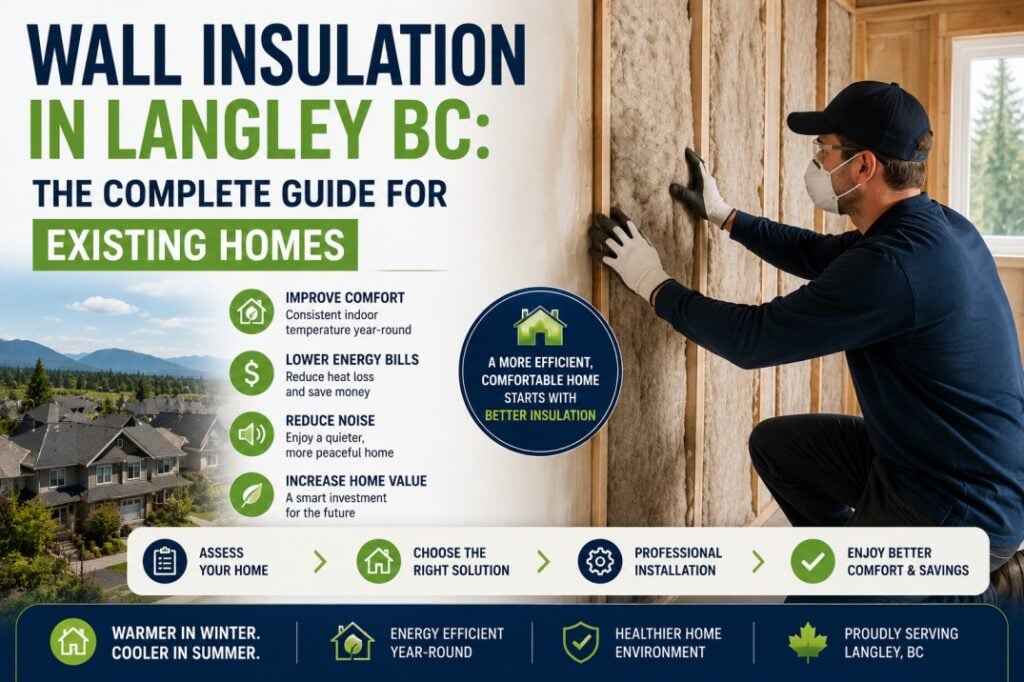
Professional contractor installing wall insulation inside an existing home in Langley, BC, illustrating energy-efficient insulation upgrades that improve comfort, reduce heat loss, and lower utility bills.

Wall Insulation in Langley BC: The Complete Guide for Existing Homes

Wall Insulation in Langley BC: The Complete Guide for Existing Homes Most Langley homeowners have had their attic insulated at some point. A growing number have also addressed their crawlspace or basement. But walls? Walls are the part of the home that people forget — even though they make up the largest surface area of your building envelope and account for up to 25% of a home’s total heat loss. In a new build, wall insulation is straightforward. But in an existing Langley home — especially one built before 1990 — upgrading wall insulation is a question that stops many homeowners in their tracks. Do you have to tear open the drywall? Is it even possible to insulate without a full renovation? What materials work best? And does it actually make a meaningful difference? This guide answers all of it clearly and practically, so Langley homeowners can make a confident, informed decision about one of the most overlooked energy efficiency upgrades available to them. Why Wall Insulation Matters More Than Most Langley Homeowners Realise Your attic loses heat fast because warm air rises. But your walls are in constant contact with the cold outdoors across the largest surface area of your home — every exterior wall, every hour of every winter day. In BC’s Climate Zone 4, which includes all of Langley and the Fraser Valley, the BC Building Code requires an effective R-value of R-22 to R-24 in exterior walls. Most Langley homes built before 2000 fall well short of that standard. The gap matters in two concrete ways. First, under-insulated walls allow heat to escape continuously through wall cavities, reducing the effectiveness of your heating system and raising your energy bills. Second, cold wall surfaces create temperature differentials that cause condensation on the interior wall face — a persistent moisture problem in BC’s damp climate that leads to mold behind drywall, deteriorating paint, and long-term damage to the wall assembly. Upgrading wall insulation in an existing Langley home doesn’t just reduce your heating bill. It makes the rooms adjacent to exterior walls feel warmer and more comfortable, reduces condensation and moisture risk, and improves the overall performance of every other insulation upgrade you’ve made elsewhere in the home. What’s Already In Your Langley Home’s Walls? Before choosing a wall insulation solution, it helps to understand what you’re working with. The answer depends almost entirely on when your home was built. Homes built before 1977 in Langley were frequently constructed with 2×4 framing and either no insulation in the wall cavity at all, or minimal fibreglass batts providing approximately R-8 to R-11. These homes are the highest priority for wall insulation upgrades — an empty or near-empty cavity is costing homeowners significantly in both energy and comfort. Homes built between 1977 and 1995 typically have R-12 fibreglass batts in 2×4 stud cavities. This was code-compliant at the time but falls well below current BC requirements of effective R-22 to R-24. R-12 cavity insulation in a 2×4 wall, once you account for thermal bridging through the studs, performs at closer to R-8 to R-9 in real-world conditions. Homes built after 1995 are more varied — many have 2×6 framing with R-19 or R-21 batts, putting them closer to current targets. However, older 2×6 homes still suffer from thermal bridging, and without a layer of continuous exterior insulation, they rarely achieve the effective R-22 to R-24 that modern standards require. Wall Insulation Options for Existing Langley Homes The right approach depends on your home’s construction, your budget, and how disruptive an upgrade you’re willing to undertake. Here are the main options: Dense-Pack Blown-In Insulation — The Retrofit Standard Dense-pack cellulose or fibreglass blown into existing wall cavities is the most practical and widely used wall insulation method for existing Langley homes — and it does not require removing drywall. Small holes (typically 2–3 inches in diameter) are drilled through either the interior drywall or the exterior cladding, and insulation is blown in under pressure until the cavity is completely filled. The holes are then patched and finished. The result is a wall cavity that goes from empty or under-filled to fully dense-packed — achieving R-13 to R-15 in a 2×4 cavity and R-20 to R-22 in a 2×6 cavity. For homes with empty or minimally insulated walls, this upgrade delivers an immediate and noticeable improvement in wall temperature, draft reduction, and energy performance. It also provides meaningful acoustic improvement, which is an added benefit for Langley homes near busy roads or with attached suites. Dense-pack is the method Western Insulation most commonly recommends for existing Langley homes where drywall removal is not already planned as part of a renovation. Spray Foam in Wall Cavities Spray foam insulation — specifically two-component closed-cell foam — can be injected into wall cavities through small access holes in a similar process to dense-pack. Closed-cell foam at R-6 to R-7 per inch achieves significantly higher R-values per inch than cellulose or fibreglass, making it the right choice for walls where cavity depth is limited and maximum thermal performance is the priority. Spray foam also acts as an air and vapour barrier within the cavity, which is particularly valuable for walls that have had moisture issues or are on the north side of a Langley home where condensation risk is highest. It does cost more per square foot than blown-in cellulose or fibreglass, but in applications where every inch of cavity space counts, the performance advantage justifies the investment. Exterior Continuous Insulation — The Code-Compliant Solution The only way to achieve the full effective R-22 to R-24 required by current BC Building Code — and to eliminate thermal bridging through wall framing — is to add a layer of continuous rigid foam insulation on the exterior of the wall, over the existing sheathing. This approach is more disruptive because it requires removing and replacing exterior cladding — but if your home’s siding is due for replacement anyway, it is the ideal time to add a 1.5

Wall Insulation in Langley BC: The Complete Guide for Existing Homes Read More »

Soundproofing Insulation in Langley BC | Walls, Floors & Ceilings

Soundproofing Insulation in Langley: How to Quieten Your Home for Good

Soundproofing Insulation in Langley: How to Quieten Your Home for Good Langley is a growing community — and with that growth comes more traffic, more neighbours, more density, and more noise. Whether you’re dealing with sound bleeding through party walls in a strata unit, bass thumping through the ceiling from the suite above, street noise disrupting sleep on a busy corridor, or simply conversations carrying between rooms in your own home, noise is one of the most underestimated quality-of-life issues in residential BC. The good news is that the solution is often already built into your walls, ceilings, and floors — it just needs to be done right. Soundproofing insulation in Langley is one of the most effective and permanent ways to reduce noise transfer in a home, and it works whether you’re building new, renovating, or retrofitting an existing space. This guide explains how it works, which materials perform best, and where in your home it makes the biggest difference. How Sound Travels Through a Home Before choosing a soundproofing solution, it helps to understand what you’re actually trying to stop. Sound travels in two ways through a building: Airborne sound is noise that travels through the air — voices, music, TV audio, traffic outside. It moves through gaps, thin walls, and poorly insulated cavities, losing very little energy along the way. Impact sound is noise created by physical contact — footsteps on a floor above, a door slamming, furniture being dragged. It vibrates the structure itself and transmits that vibration through the building’s framing. Most residential noise complaints involve a combination of both. The right soundproofing insulation approach addresses both transmission paths — filling cavities to absorb airborne sound and decoupling surfaces to interrupt the path of impact vibration. Which Insulation Materials Work Best for Soundproofing in Langley? Not all insulation materials absorb sound equally. When noise reduction is a priority alongside thermal performance, material selection matters. Mineral Wool (Rock Wool) Mineral wool is the gold standard for acoustic insulation. Dense, heavy, and tightly packed, it absorbs sound waves rather than reflecting them — and it does so across a wide frequency range, meaning it handles both high-pitched noise like voices and low-frequency sound like bass or mechanical vibration. It also provides strong thermal performance and is non-combustible, making it a favourite for party walls between suites and strata units. When Langley homeowners ask us what performs best in walls between units, mineral wool is consistently the answer. Dense-Pack Cellulose Blown-in cellulose is another high-performing acoustic option, particularly for retrofitting existing walls without full drywall removal. The dense-pack method fills every cavity with compacted cellulose fibre, leaving no voids for sound to travel through. It’s an excellent choice for older Langley homes where hollow wall cavities are a major contributor to noise transfer, and where a full renovation isn’t practical. Open-Cell Spray Foam Spray foam insulation — specifically the open-cell variety — also provides meaningful acoustic performance. Open-cell foam expands to fill every gap and irregularity in a wall cavity, absorbing sound and eliminating the air pathways that airborne noise travels through. It’s particularly effective when combined with other soundproofing strategies like resilient channels or acoustic caulking, and its air-sealing properties mean it stops both drafts and noise in a single application. Fibreglass Batts Standard fibreglass batt insulation provides a moderate level of noise reduction and is a common baseline in new construction. While it outperforms an empty wall cavity, it doesn’t match mineral wool or dense-pack cellulose for pure acoustic performance. That said, it remains a practical and cost-effective choice in applications where sound control is secondary to thermal performance. Where in Your Langley Home Does Soundproofing Insulation Make the Most Difference? The impact of soundproofing insulation depends heavily on where it’s installed. Some locations deliver far more return than others. Party Walls Between Units or Suites If you have a secondary suite, basement suite, or share a wall with a neighbour in a strata or semi-detached home, the party wall is almost always the priority. In Langley’s growing strata market, noise between units is one of the most common complaints — and in most cases, the wall cavity between units contains little to no acoustic insulation. Upgrading to mineral wool in these walls can transform the livability of both spaces. Floor and Ceiling Assemblies Sound between floors is particularly intrusive — footsteps, dropped items, and impact noise from the level above are difficult to ignore. Insulating the floor/ceiling assembly with mineral wool or dense-pack cellulose, combined with resilient clips or channels that decouple the ceiling from the structure above, is the most effective solution. This approach is especially relevant in Langley homes with basement suites or multi-storey layouts. Exterior Walls Facing Busy Roads Langley’s rapid development has brought more traffic to areas that were previously quiet. Exterior walls facing major roads or corridors benefit significantly from dense insulation that absorbs the broadband noise of traffic, particularly when combined with upgraded windows and door seals. Home Offices and Bedrooms Even within the same unit, noise between an open-plan living area and a bedroom or home office can reduce comfort and productivity significantly. Interior wall insulation in these specific locations is a relatively low-cost, high-impact upgrade for anyone working from home or light-sleeping in a busy household. Soundproofing and Thermal Performance: A Two-for-One Upgrade One of the most practical aspects of soundproofing insulation in Langley is that it doesn’t just reduce noise — it improves your home’s thermal envelope at the same time. Mineral wool, dense-pack cellulose, and spray foam all deliver meaningful R-values alongside their acoustic properties, meaning a single upgrade addresses both your comfort goals simultaneously. For Langley homeowners who’ve already improved their attic with blown-in insulation or addressed crawlspace moisture with basement and crawlspace insulation, adding soundproofing insulation to interior walls and floor assemblies completes a whole-home comfort strategy. The result is a home that holds heat better, costs less to run, and is significantly quieter — all at once. It’s also worth noting

Soundproofing Insulation in Langley: How to Quieten Your Home for Good Read More »

Crawlspace Insulation in Langley BC | Costs, Types & Moisture Control

Crawlspace Insulation in Langley: What BC Homeowners Need to Know

Crawlspace Insulation in Langley: What BC Homeowners Need to Know If the floors in your Langley home feel cold in winter no matter how high you turn the heat, or if your energy bills keep creeping up year after year, the problem may not be in your walls or your attic — it could be directly beneath your feet. The crawlspace is one of the most overlooked and underinsulated areas of a home in BC, and in Langley’s damp, variable climate, poor crawlspace insulation doesn’t just cost you money. It can lead to mold growth, wood rot, pest infestations, and serious long-term damage to your home’s structure. In this guide, the team at Western Insulation walks you through everything Langley homeowners need to know about crawlspace insulation — from what it is and why it matters, to the best insulation types for BC’s climate, realistic costs, and the rebates available to reduce your investment. Why Crawlspace Insulation Matters in Langley’s Climate Langley sits in the heart of the Fraser Valley, where winters bring sustained damp cold and ground moisture levels are consistently high. A crawlspace that isn’t properly insulated and sealed acts like a cold, humid chamber sitting directly under your living areas — and your home pays the price. The consequences of an uninsulated or poorly insulated crawlspace include: Cold floors and uneven temperatures. Heat from your living space escapes down through uninsulated floor joists, leaving ground-floor rooms perpetually cold regardless of your thermostat setting. Mold and moisture damage. Warm air from inside meets cold crawlspace surfaces and condenses. Over time this creates the moisture conditions mold needs to thrive — and once mold is established in a crawlspace, it spreads. This is one of the most common issues our team finds during inspections across Langley homes, and it’s the reason we always recommend addressing crawlspace moisture before any new insulation goes in. For more on how insulation and moisture interact, see our complete guide to attic insulation removal and replacement in Langley. Higher heating and cooling bills. An uninsulated crawlspace undermines the performance of every other insulation upgrade in your home. You can have a perfectly insulated attic and still lose significant heat through the floor if the crawlspace is neglected. Pest entry points. Exposed, uninsulated crawlspaces are an open invitation for rodents and insects. Insulation combined with proper sealing eliminates the gaps and warmth gradients that attract pests. Types of Crawlspace Insulation: Which Is Best for Langley Homes? Not all insulation materials perform equally in a crawlspace environment. The key difference from attic insulation is moisture: crawlspaces in the Fraser Valley are damp by nature, and any material you use must be able to handle that environment without absorbing moisture, sagging, or growing mold. Closed-Cell Spray Foam For most Langley crawlspaces, closed-cell spray foam insulation is the top-performing choice. Applied directly to crawlspace walls and rim joists, it acts as both insulation and a vapour barrier simultaneously. With an R-value of approximately R-6 to R-7 per inch, it delivers high thermal resistance in a thin profile, and it doesn’t absorb moisture or support mold growth. It also seals air gaps completely — critical for preventing cold air infiltration in Langley winters. Rigid Foam Board Rigid foam insulation is a cost-effective alternative for crawlspace walls. Installed against foundation walls in panels, it provides solid R-value per inch and excellent moisture resistance. XPS (extruded polystyrene) board in particular performs well in wet conditions and is a common choice for Langley basement walls and crawlspace perimeters. Fibreglass Batts (With Caution) Traditional fibreglass batts can be used in crawlspace floor joists but come with a significant caveat in BC’s climate: fibreglass absorbs and holds moisture. In a damp crawlspace, fibreglass batts will sag, lose R-value, and can fall out over time. If batts are used, a proper vapour barrier is non-negotiable. Our team generally recommends spray foam or rigid foam over batts for any Langley crawlspace due to the local moisture conditions. If you want to understand how batt insulation compares in other applications, see our batt insulation page. The Role of the Vapour Barrier No crawlspace insulation job in Langley is complete without a vapour barrier — and this is where many DIY installations fall short. A vapour barrier is a heavy-duty polyethylene liner (minimum 6 mil, ideally 10–20 mil) that covers the crawlspace floor and laps up the walls. Its job is to block ground moisture from evaporating up into the space above it. In BC, the Building Code requires vapour barriers in crawlspaces. When combined with proper insulation, a quality vapour barrier: Western Insulation installs vapour barriers as part of every crawlspace insulation project in Langley. We assess the existing moisture conditions during our initial inspection and recommend the right liner thickness for your home’s specific situation. How Much Does Crawlspace Insulation Cost in Langley? Crawlspace insulation costs in Langley vary based on the size of the space, the material used, and whether a vapour barrier and air sealing are included. As a general guide: The good news is that crawlspace insulation upgrades may qualify for BC Hydro and FortisBC rebate programs. Eligible homeowners can access up to $5,500 back on qualifying energy efficiency upgrades. Western Insulation handles all rebate paperwork on your behalf. Learn more on our BC insulation rebates page. What to Expect From a Professional Crawlspace Insulation Job A proper crawlspace insulation project in Langley involves more than just adding material. When you book with Western Insulation, here’s what the process looks like: 1. Inspection and assessment. We inspect the crawlspace for existing moisture damage, mold, pest evidence, air bypass locations, and the condition of any existing insulation. If old material needs to come out, our insulation removal team handles it cleanly before new work begins. 2. Air sealing. All gaps, penetrations, and rim joist areas are sealed to stop cold air infiltration. This step makes a significant difference to the thermal performance of the finished job. 3. Vapour barrier installation. A code-compliant polyethylene

Crawlspace Insulation in Langley: What BC Homeowners Need to Know Read More »

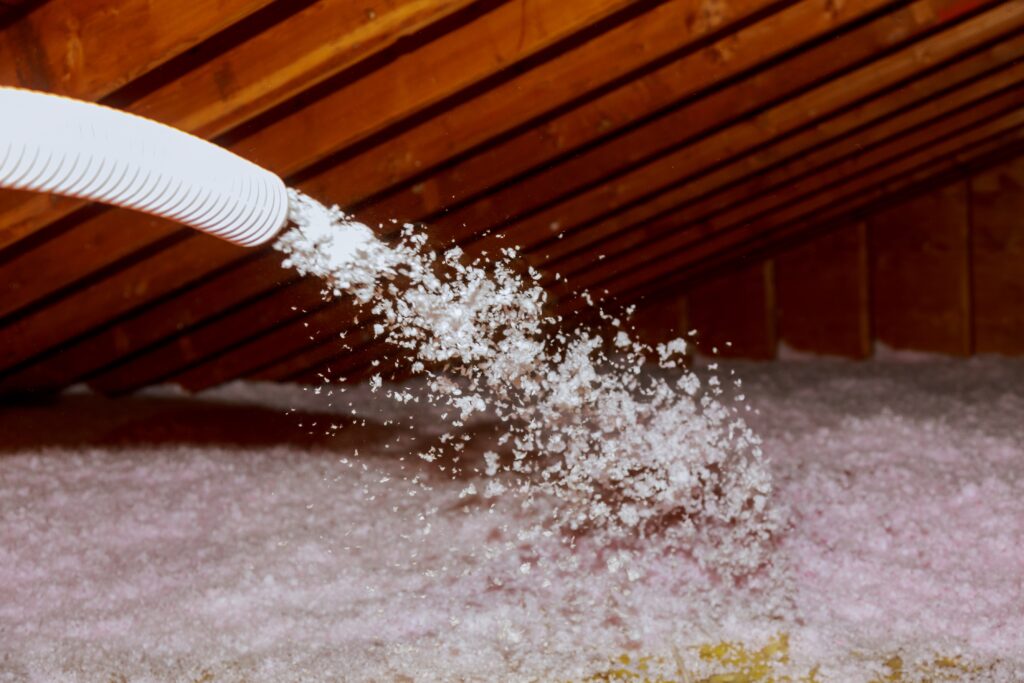
Spraying Blown Fiberglass

The Ultimate Guide to Spray Foam Insulation in Langley: Costs, R-Values, and Energy Savings

The Ultimate Guide to Spray Foam Insulation in Langley: Costs, R-Values, and Energy Savings When it comes to protecting your home from the damp winters and humid summers of the Fraser Valley, not all insulation is created equal. If you are noticing cold drafts in your living room or skyrocketing BC Hydro bills, it may be time to look into the best spray foam insulation solutions available. At Western Insulation, we have spent over 25 years helping Langley homeowners transform their properties into airtight, energy-efficient sanctuaries. In this guide, we’ll break down everything you need to know about spray foam insulation, from the technical spray foam insulation R-value to the actual spray foam insulation cost in today’s market. What is Spray Foam Insulation? If you’ve been searching for “what is spray foam insulation,” the simplest answer is that it is a chemical product (polyurethane) that expands upon application. Unlike traditional fiberglass batts that leave small gaps, spray foam expands up to 100 times its liquid volume. This expansion allows spray foam insulation installers to seal every tiny crack, crevice, and rim joist, creating a continuous air barrier. For Langley residents, this means no more “stack effect”—where warm air escapes through the attic while drawing cold, damp air in through the crawlspace. Understanding Spray Foam Insulation R-Value One of the most frequent questions we get as spray foam insulation contractors is about the “R-value.” Simply put, R-value measures a material’s resistance to heat flow. The higher the number, the better the insulation. By choosing the right R-value, you can meet or exceed the BC Building Code requirements while using less space than traditional materials. Spray Foam Insulation Cost in Langley Many homeowners ask, “Is the spray foam insulation cost worth it?” While the upfront investment for spray foam insulation companies is higher than blown-in cellulose or fiberglass, the long-term ROI is unmatched. In the Lower Mainland, you can expect to pay anywhere from $1.50 to $4.50 per square foot, depending on the thickness required and whether you choose open or closed-cell foam. However, when you factor in the up to 40% reduction in monthly energy bills and the current BC Hydro and FortisBC rebates (which can reach up to $5,500 for whole-home upgrades), the system often pays for itself within 3 to 5 years. Key Applications: Where Do You Need It Most? 1. Attic Spray Foam Insulation The attic is the primary source of heat loss in most Langley homes. Attic spray foam insulation applied to the underside of the roof deck (hot roof design) can eliminate ice dams in the winter and keep your upper floors significantly cooler during those July heatwaves. 2. Spray Foam Insulation in Existing Walls Are you tired of “cold spots” in your home? We often specialize in spray foam insulation in existing walls near me. By using specialized injection techniques or applying foam during a renovation, we can seal the building envelope without a complete tear-down. 3. Basements and Crawlspaces Langley’s high water table makes moisture a constant threat. Closed-cell spray foam is the only insulation that won’t sag or hold water if a minor leak occurs, preventing the growth of mold and mildew. Why Choose Western Insulation as Your Spray Foam Company? If you are searching for “spray foam insulation contractors near me” or a “spray foam insulation company near me,” experience matters. Spray foam is a science; if the chemical mix or temperature is off by even a few degrees, the insulation won’t cure properly. The Western Insulation Advantage: Ready to Upgrade Your Home? Stop searching for “spray foam insulation companies near me” and start working with the experts. Whether you are building a new home in Willoughby or retrofitting a heritage house in Fort Langley, Western Insulation has the tools and expertise to get the job done right. Contact Western Insulation today for a free, no-obligation assessment of your Langley home. Let us show you how the right spray foam insulation can save you money and improve your family’s comfort for decades to come. Frequently Asked Questions (FAQ) Is spray foam insulation safe? Yes. When installed by professional spray foam insulation companies, the product is completely safe. We follow strict ventilation protocols, and once the foam is cured (usually within 24 hours), it becomes an inert, non-toxic material. Can I do DIY spray foam? While small kits exist, for whole-home projects like attic spray foam insulation, it is highly recommended to hire professional spray foam insulation contractors. Precision is required to ensure the R-value is consistent and the air seal is perfect. How long does it last? Unlike fiberglass which can settle or cellulose which can degrade, best spray foam insulation lasts for the lifetime of the building. It does not sag, shrink, or lose its R-value over time.

The Ultimate Guide to Spray Foam Insulation in Langley: Costs, R-Values, and Energy Savings Read More »

bc-hydro.png
clean-bc.png
fortis-bc.png
Get Rebates On Your Insulation