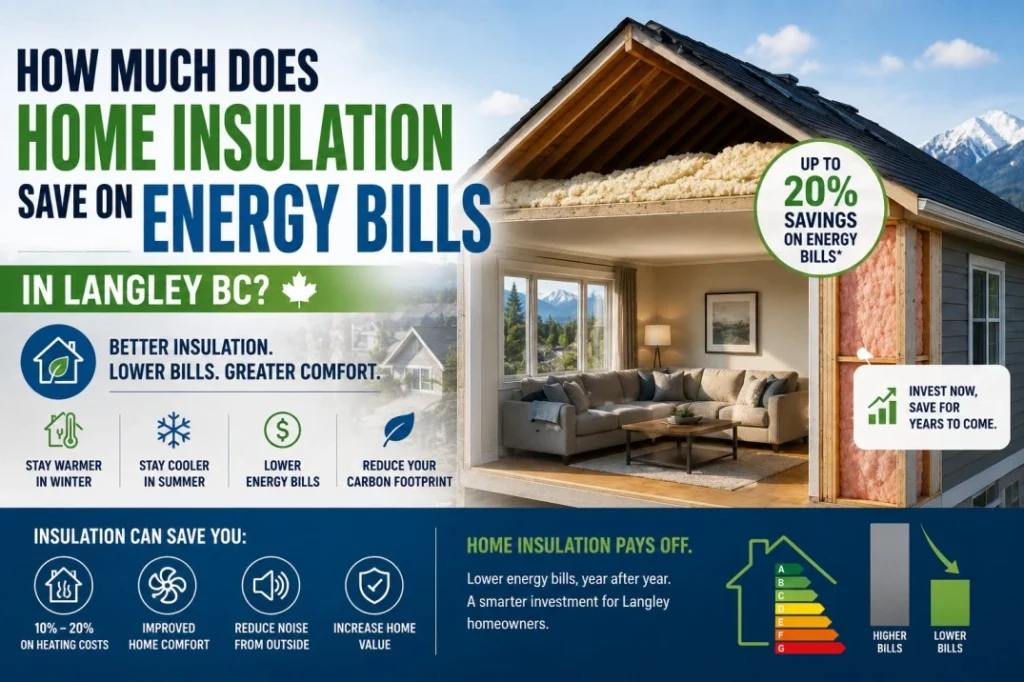
How Much Does Home Insulation Save on Energy Bills in Langley BC?
The short answer: a properly insulated Langley home saves between 10% and 30% on annual heating and cooling costs, with most whole-home upgrades delivering payback within three to five years — and up to $5,500 in BC rebates reducing the upfront investment significantly.
But the short answer only tells part of the story. The amount you save depends on which part of your home is insulated, what material is used, how well it is installed, and how under-insulated your home was to begin with. A Langley home that has never had its crawlspace or walls insulated will see far greater savings than one where only an attic top-up is needed.
This guide breaks it down clearly — zone by zone, number by number — so you know exactly what to expect before you book a single assessment.
Why Energy Savings From Insulation Are Higher in Langley Than Most Canadians Expect
Langley sits in BC Climate Zone 4 — a climate defined by sustained damp cold in winter, significant temperature swings between seasons, and a heating season that runs from October through April. Unlike prairie cities where extreme cold dominates, Langley’s challenge is the persistence of cool, wet conditions that put constant pressure on your home’s building envelope.
This persistent pressure means heat loss in an under-insulated Langley home is not occasional — it is continuous. Your furnace or heat pump is compensating for that loss every hour of every day during the heating season. The cumulative energy cost of that compensation is what proper insulation eliminates — and in BC, heating and cooling account for approximately 60 to 65% of a typical household’s total energy bill.
According to BC Hydro and FortisBC program data, typical homeowners save at least 10% on their home’s energy costs after an insulation upgrade. Western Insulation’s own project data across more than 2,400 completed homes in the Fraser Valley puts the average savings from a full attic and crawlspace upgrade at 20 to 30% — a figure consistent with Natural Resources Canada research on whole-home insulation performance.
Energy Savings by Zone: Where Insulation Delivers the Most Impact
Different parts of your home lose heat at different rates — and understanding which zones deliver the highest return helps you prioritise your investment.
Attic Insulation: The Highest Single Impact
The attic is the single largest source of heat loss in a typical Langley home. Heat rises naturally, and without sufficient R-value above the ceiling plane, it escapes continuously through the roof — regardless of what the rest of your home’s envelope looks like.
Expected savings: 15 to 25% reduction in heating costs for homes moving from R-20 or below to R-50 or R-60.
Most Langley homes built before 2000 have attic insulation sitting between R-12 and R-30 — well below the current BC Building Code minimum of R-40 to R-50 and the R-60 that our attic insulation service in Langley BC targets for optimal Fraser Valley performance. The gap between what these homes have and what they need is measured directly in monthly energy costs.
A household spending $250 per month on heating with an attic at R-20 that upgrades to R-60 can expect to reduce that specific portion of heat loss by 25 to 40%, depending on ceiling area and construction. For a 1,200 square foot attic floor, this translates to a meaningful and measurable reduction in monthly bills — one that accumulates month after month through every heating season for the 25 to 30-year life of the insulation.
Crawlspace Insulation: The Most Underestimated Saving
Poorly insulated walls, attics, or basements can cause up to 40% of a home’s total heat loss — forcing your heating and cooling systems to work harder than they should. The crawlspace’s contribution to that figure is consistently underestimated because it is invisible — Langley homeowners do not see the cold air entering through uninsulated floor joists the way they feel a draft from a window.
Expected savings: 10 to 15% reduction in total home heating costs for homes with previously uninsulated crawlspaces.
Cold floors above an uninsulated crawlspace are one of the most consistent complaints from Langley homeowners in older homes — and they are a direct expression of the energy loss happening beneath your feet. Our crawlspace and basement insulation service for Langley homes uses closed-cell spray foam and a heavy-duty vapour barrier to address both the thermal loss and the moisture conditions that compound the energy problem in BC’s damp climate.
Wall Insulation: The Largest Surface Area, The Biggest Opportunity
Exterior walls represent the largest surface area of your home’s building envelope — and in a Langley home built before 1995, those walls are almost certainly under-insulated relative to current BC standards. Empty or minimally insulated 2×4 wall cavities perform at R-8 or below in real-world conditions, against a BC code requirement of effective R-22 to R-24.
Expected savings: 10 to 20% reduction in total energy costs for homes with empty or near-empty wall cavities that are brought to full density.
Our wall insulation retrofit guide for existing Langley homes explains how dense-pack blown-in insulation through small access holes — without drywall removal — brings those cavities to R-13 to R-22 depending on framing depth. This is the most underutilised energy upgrade available to existing Langley homes, and it is one where the absence of local competitor content means homeowners frequently do not realise it is an option without demolition.
Whole-Home Insulation: Where the Numbers Compound
The most significant energy savings come when attic, crawlspace, and wall insulation are addressed as a coordinated system. Heat loss pathways are interconnected — plugging one without addressing others delivers partial results.
Expected savings for a whole-home upgrade across all zones: 20 to 30% reduction in total annual energy costs.
For a Langley household with a combined heating and cooling bill of $3,000 per year, a 25% reduction represents $750 in annual savings — every year, for the life of the insulation. Over a 20-year period, that is $15,000 in cumulative savings from an investment that, after BC rebates, may cost $5,000 to $8,000 net. The return on investment case for whole-home insulation in Langley is one of the strongest of any home improvement category available to BC homeowners.
How BC Rebates Change the Savings Equation
The financial return on insulation in Langley is significantly improved by the BC Hydro and FortisBC rebate programs currently available to eligible homeowners.
BC Hydro confirms that upgrading insulation saves at least 10% of your home’s energy cost and improves comfort all year. BC Hydro’s rebate structure pays per R-value added per square foot: attic insulation upgrades qualify for up to $900, basement and crawlspace upgrades for up to $1,200, and exterior wall cavity upgrades for up to $1,200. Combined across multiple zones in a single project, eligible Langley homeowners can access up to $5,500 in total rebates.
Home insulation in Canada typically pays back within 3 to 5 years. When BC rebates are applied, that payback period shortens further — making the case for acting now rather than waiting one of the most straightforward financial arguments in home improvement.
Western Insulation is a certified HPCN contractor and manages the entire BC Hydro and FortisBC insulation rebate process in Langley on behalf of every client, from pre-work eligibility checks through to final submission. Every qualifying project is documented to program requirements so no rebate dollars are left unclaimed.
What Affects How Much Your Langley Home Saves?
Three factors determine how much your specific home saves from an insulation upgrade — beyond the general numbers outlined above:
Your starting point. A home at R-12 in the attic saves more by upgrading to R-60 than a home already at R-40. The greater the gap between current performance and the target, the larger the savings.
Installation quality. A correctly installed R-21 batt insulation assembly performs very differently from a compressed or poorly fitted one. Western Insulation’s approach — precise fitting, thorough air sealing, and zero shortcuts on penetration sealing — is what ensures the rated R-value is what your home actually performs at. For more on why this matters, read our complete fibreglass and mineral wool batt insulation guide for Langley BC.
Air sealing. Research consistently shows that homes receiving both air sealing and insulation upgrades save 25 to 40% on energy costs. Homes receiving only insulation without air sealing save 10 to 15%. The difference is that insulation slows heat transfer but does not stop warm air physically escaping through unsealed gaps. Both are required for maximum performance — and both are standard in every project Western Insulation completes in Langley.
How to Find Out What Your Langley Home Can Save
The most accurate way to understand your specific home’s energy saving potential is a professional insulation assessment — not an estimate based on square footage, and not a number extrapolated from national averages.
Western Insulation provides free home insulation assessments across Langley, covering every zone of your home against current BC Building Code R-value requirements. We identify your existing insulation levels in the attic, walls, crawlspace, and basement, locate air bypass points that are undermining your current insulation’s performance, confirm which BC rebate programs your home qualifies for, and provide a written quote with realistic energy saving projections for your specific property.
We serve Langley and the wider Fraser Valley including insulation services in Surrey, insulation services in Abbotsford, insulation services in Burnaby, insulation services in Mission, insulation services in Coquitlam, and insulation services in Vancouver.
Book a free home insulation energy savings assessment in Langley and find out exactly what your home can save — with real numbers, a written quote, and full BC rebate support from the Fraser Valley’s top-rated insulation contractor.