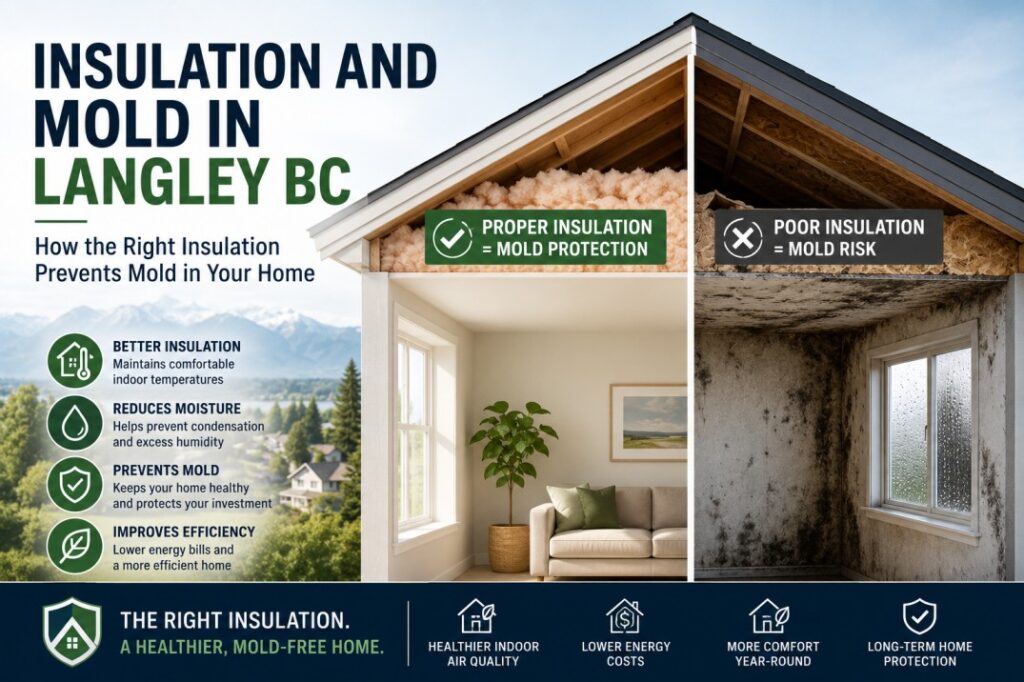
Insulation and Mold in Langley BC: How the Right Insulation Prevents Mold in Your Home
Langley has one of the dampest climates in Canada. The Fraser Valley’s wet winters, persistent ground moisture, and frequent temperature cycling between mild and cold create conditions where mold does not just grow — it thrives. And in a home with poorly installed, damaged, or absent insulation, mold finds exactly what it needs to establish itself behind drywall, in attic sheathing, along floor joists, and throughout crawlspace framing — often for years before a homeowner notices.
The connection between insulation and mold is one of the least understood aspects of home performance in BC. Most homeowners think of insulation as an energy product and mold as a hygiene problem. In reality, they are two sides of the same coin. The conditions that allow mold to take hold — persistent moisture, condensation, stagnant cold air, inadequate vapour control — are exactly the conditions that well-installed, appropriate insulation prevents. Get the insulation right and you eliminate the moisture conditions that mold depends on. Get it wrong — or skip it entirely — and you create them.
This guide explains the relationship clearly, covers the specific locations in a Langley home where insulation and mold interact most critically, and tells you what to do whether you are trying to prevent a problem or address one that already exists.
Why Langley’s Climate Makes Mold a Serious Risk
Mold requires three things to grow: a food source, the right temperature, and moisture. In a Langley home, moisture is the critical variable — and it is the one that insulation directly controls.
BC’s Lower Mainland receives among the highest annual rainfall of any major Canadian region. Ground moisture levels are consistently elevated throughout the year. Temperatures in Langley cycle repeatedly through the freeze-thaw range during winter — a pattern that drives condensation on cold surfaces inside wall assemblies, attic sheathing, and crawlspace framing every time the temperature drops.
In a well-insulated home with proper vapour control, these external conditions have little impact on the interior of the building envelope. Warm interior surfaces do not allow condensation to form. Air bypasses are sealed so humid interior air cannot reach cold structural surfaces. The crawlspace floor is covered with a vapour barrier that prevents ground moisture from evaporating upward.
In a poorly insulated home — or one where insulation has degraded, compressed, or been damaged — those protections are absent. Cold surfaces inside the building envelope reach dew point, condensation forms, and mold follows. It is not a question of if. It is a question of when and how much.
The Four Places Insulation and Mold Interact in Langley Homes
1. The Attic
The attic is the most common location for mold problems in Langley homes — and inadequate or improperly installed insulation is almost always a contributing factor. Here is how it happens.
Warm, moist air from your living space rises naturally toward the ceiling. In a properly air-sealed attic, that air is blocked by thorough sealing around every penetration — light fixtures, plumbing stacks, wall top plates, and the attic hatch. In an attic that has not been air-sealed, that warm moist air travels freely through gaps in the ceiling plane and rises into the cold attic space above.
When warm humid air meets the cold surface of the roof decking in winter, it condenses. Repeated condensation on wood sheathing creates the moisture film that mold needs to germinate. Left unaddressed, this leads to visible mold growth on roof decking, deterioration of structural timber, and eventually significant remediation costs.
The fix is not simply adding more insulation on top of existing material — it is air sealing every bypass location first, then bringing the insulation to the correct R-value. Air sealing removes the pathway for warm moist air to reach cold attic surfaces. Adequate insulation keeps the ceiling plane warm enough to prevent condensation even when minor air movement occurs. Both steps together are what Western Insulation’s attic insulation service includes as standard on every Langley project — because doing one without the other leaves the moisture problem partially unaddressed.
If mold is already present in your attic when you book an insulation upgrade, the correct sequence is professional removal of contaminated existing insulation first — our insulation removal service handles this — followed by air sealing, and then new insulation installation. Adding new blown-in insulation on top of mold-contaminated material does not resolve the mold. It covers it, and the problem continues underneath.
2. The Crawlspace
The crawlspace is the second most common location for mold in Langley homes — and in many cases the most damaging, because crawlspace mold reaches structural floor joists, subfloor panels, and the underside of finished flooring before it is noticed.
An uninsulated, unsealed crawlspace in Langley is a moisture factory. Ground moisture evaporates upward into the crawlspace air continuously. Without a vapour barrier and proper insulation, that moisture-laden air has nowhere to go — it contacts the cold underside of the floor structure above and condenses. In a Langley winter, this cycle repeats daily.
Fibreglass batts installed in crawlspace floor joists absorb moisture and compound the problem — wet fibreglass holds moisture against the joists it is supposed to protect and becomes a food source for mold itself. This is one of the key reasons Western Insulation recommends against fibreglass batts in crawlspace applications in BC’s climate and instead uses closed-cell spray foam insulation on crawlspace walls combined with a heavy-duty polyethylene vapour barrier on the crawlspace floor. Closed-cell spray foam does not absorb moisture, does not provide a food source for mold, and acts as both insulation and vapour barrier simultaneously — eliminating the conditions mold needs rather than just slowing heat loss.
For a complete guide to addressing crawlspace moisture and insulation together, see our basement and crawlspace insulation page.
3. Exterior Walls
Wall-cavity mold is less visible and less commonly discussed than attic or crawlspace mold — but it is a genuine risk in Langley homes, particularly in older homes with inadequate vapour barriers and compressed or missing insulation.
The mechanism is the same: warm interior air carries moisture toward the exterior. When it meets a cold surface within the wall assembly — typically the exterior sheathing in winter — it condenses. In a wall with a properly installed vapour barrier on the warm interior face of the insulation, this moisture is blocked from reaching the cold sheathing. In a wall where the vapour barrier is missing, damaged, or improperly lapped, warm moist air reaches the cold sheathing and condensation occurs within the wall cavity.
Over time this creates a mold environment that is completely hidden and that can continue for years without visible signs inside the home. By the time it is detected — usually during a renovation that opens the wall, or when a musty odour becomes persistent — the damage has typically spread well beyond the original condensation zone.
The solution in existing Langley homes is ensuring wall cavities are fully filled with insulation (using dense-pack blown-in through small access holes where drywall is closed), that vapour control is addressed, and that any damaged or contaminated material is removed before new insulation goes in. Our wall insulation guide for Langley homes covers the retrofit options in detail.
4. Rim Joists and Band Joists
The rim joist — the perimeter framing at the top of your foundation wall — is one of the most consistently overlooked mold locations in Langley homes. It is a cold, exposed structural element that is in direct contact with the cold foundation and is often uninsulated or poorly insulated with fibreglass batts that have compressed or fallen out over time.
Cold rim joists attract condensation from the warm interior air above them, and that condensation accumulates directly on structural framing wood. In BC’s damp climate, a cold, uninsulated rim joist in a Langley home is a mold risk that develops quietly and is rarely inspected until a renovation forces access.
Closed-cell spray foam applied directly to rim joists — as part of a broader crawlspace or basement insulation project — bonds to the framing, insulates it, and eliminates the condensation surface simultaneously. It is the most effective and permanent solution for rim joist moisture and mold risk in BC homes.
What to Do If Mold Is Already Present in Your Insulation
Mold found in existing attic or crawlspace insulation during an inspection does not mean your home is unsalvageable — but it does mean the correct sequence of work matters considerably.
The first step is confirming the extent of the problem through a professional inspection. Our team identifies affected material, assesses the moisture source driving the mold growth, and determines whether the mold has reached structural materials beyond the insulation itself.
Contaminated insulation must be removed completely before new material is installed. Our industrial vacuum removal process extracts all affected material safely, and the affected area is inspected and allowed to dry before any remediation work proceeds. Where mold has reached structural wood — attic sheathing, floor joists, or crawlspace framing — remediation of those surfaces is recommended before encapsulation.
New insulation is then installed using the correct product for the specific location — one that does not absorb moisture, does not provide a food source for mold recurrence, and includes appropriate vapour control for BC’s climate zone. Air sealing is completed at the same time to eliminate the moisture pathway that created the problem initially.
Western Insulation serves Langley and surrounding communities including Surrey, Abbotsford, Burnaby, Mission, Coquitlam, and Vancouver.
Prevent the Problem Before It Starts
The most cost-effective approach to mold and insulation in a Langley home is prevention — and prevention means addressing insulation, air sealing, and vapour control as a coordinated system rather than as separate products.
A free home insulation assessment with Western Insulation covers every zone of your home: attic, crawlspace, basement walls, rim joists, and exterior walls where relevant. We identify existing moisture conditions, check current insulation levels against BC Building Code requirements, locate air bypass points that allow warm moist air to reach cold surfaces, and recommend the specific combination of products and methods that will eliminate the moisture conditions mold depends on in your specific home.
Eligible Langley homeowners can also access up to $5,500 in BC Hydro and FortisBC rebates on qualifying insulation upgrades — making the financial case for addressing these issues now even stronger.
Book your free mold and insulation assessment with Western Insulation today. Our Langley team will inspect your home, identify your risk areas, and give you a clear, honest recommendation with no obligation.