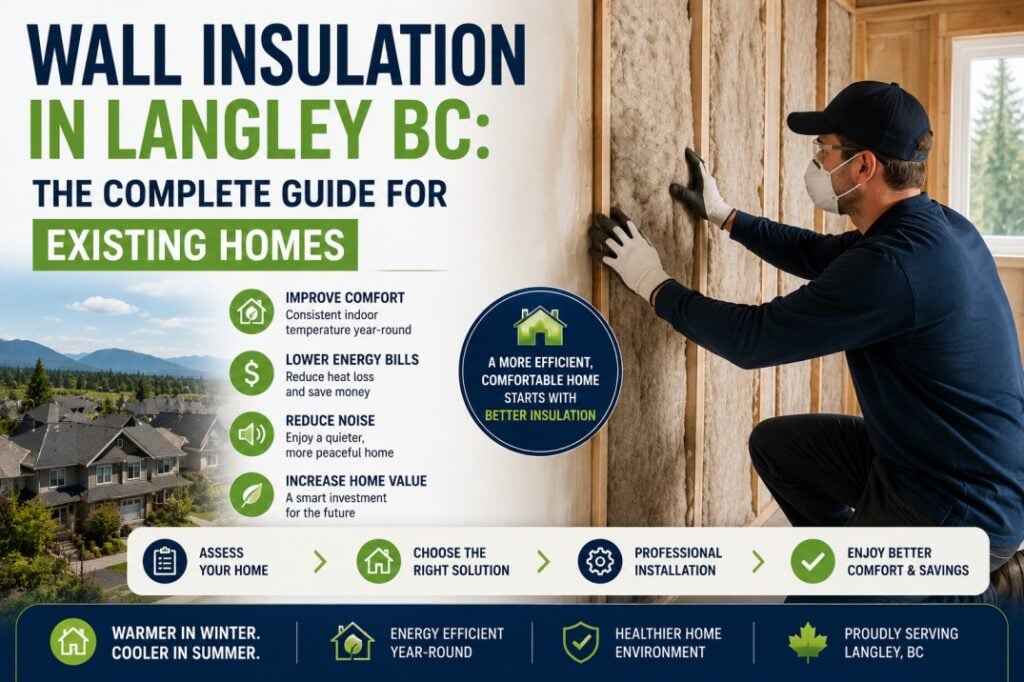
Wall Insulation in Langley BC: The Complete Guide for Existing Homes
Most Langley homeowners have had their attic insulated at some point. A growing number have also addressed their crawlspace or basement. But walls? Walls are the part of the home that people forget — even though they make up the largest surface area of your building envelope and account for up to 25% of a home’s total heat loss.
In a new build, wall insulation is straightforward. But in an existing Langley home — especially one built before 1990 — upgrading wall insulation is a question that stops many homeowners in their tracks. Do you have to tear open the drywall? Is it even possible to insulate without a full renovation? What materials work best? And does it actually make a meaningful difference?
This guide answers all of it clearly and practically, so Langley homeowners can make a confident, informed decision about one of the most overlooked energy efficiency upgrades available to them.
Why Wall Insulation Matters More Than Most Langley Homeowners Realise
Your attic loses heat fast because warm air rises. But your walls are in constant contact with the cold outdoors across the largest surface area of your home — every exterior wall, every hour of every winter day. In BC’s Climate Zone 4, which includes all of Langley and the Fraser Valley, the BC Building Code requires an effective R-value of R-22 to R-24 in exterior walls. Most Langley homes built before 2000 fall well short of that standard.
The gap matters in two concrete ways. First, under-insulated walls allow heat to escape continuously through wall cavities, reducing the effectiveness of your heating system and raising your energy bills. Second, cold wall surfaces create temperature differentials that cause condensation on the interior wall face — a persistent moisture problem in BC’s damp climate that leads to mold behind drywall, deteriorating paint, and long-term damage to the wall assembly.
Upgrading wall insulation in an existing Langley home doesn’t just reduce your heating bill. It makes the rooms adjacent to exterior walls feel warmer and more comfortable, reduces condensation and moisture risk, and improves the overall performance of every other insulation upgrade you’ve made elsewhere in the home.
What’s Already In Your Langley Home’s Walls?
Before choosing a wall insulation solution, it helps to understand what you’re working with. The answer depends almost entirely on when your home was built.
Homes built before 1977 in Langley were frequently constructed with 2×4 framing and either no insulation in the wall cavity at all, or minimal fibreglass batts providing approximately R-8 to R-11. These homes are the highest priority for wall insulation upgrades — an empty or near-empty cavity is costing homeowners significantly in both energy and comfort.
Homes built between 1977 and 1995 typically have R-12 fibreglass batts in 2×4 stud cavities. This was code-compliant at the time but falls well below current BC requirements of effective R-22 to R-24. R-12 cavity insulation in a 2×4 wall, once you account for thermal bridging through the studs, performs at closer to R-8 to R-9 in real-world conditions.
Homes built after 1995 are more varied — many have 2×6 framing with R-19 or R-21 batts, putting them closer to current targets. However, older 2×6 homes still suffer from thermal bridging, and without a layer of continuous exterior insulation, they rarely achieve the effective R-22 to R-24 that modern standards require.
Wall Insulation Options for Existing Langley Homes
The right approach depends on your home’s construction, your budget, and how disruptive an upgrade you’re willing to undertake. Here are the main options:
Dense-Pack Blown-In Insulation — The Retrofit Standard
Dense-pack cellulose or fibreglass blown into existing wall cavities is the most practical and widely used wall insulation method for existing Langley homes — and it does not require removing drywall. Small holes (typically 2–3 inches in diameter) are drilled through either the interior drywall or the exterior cladding, and insulation is blown in under pressure until the cavity is completely filled. The holes are then patched and finished.
The result is a wall cavity that goes from empty or under-filled to fully dense-packed — achieving R-13 to R-15 in a 2×4 cavity and R-20 to R-22 in a 2×6 cavity. For homes with empty or minimally insulated walls, this upgrade delivers an immediate and noticeable improvement in wall temperature, draft reduction, and energy performance. It also provides meaningful acoustic improvement, which is an added benefit for Langley homes near busy roads or with attached suites.
Dense-pack is the method Western Insulation most commonly recommends for existing Langley homes where drywall removal is not already planned as part of a renovation.
Spray Foam in Wall Cavities
Spray foam insulation — specifically two-component closed-cell foam — can be injected into wall cavities through small access holes in a similar process to dense-pack. Closed-cell foam at R-6 to R-7 per inch achieves significantly higher R-values per inch than cellulose or fibreglass, making it the right choice for walls where cavity depth is limited and maximum thermal performance is the priority.
Spray foam also acts as an air and vapour barrier within the cavity, which is particularly valuable for walls that have had moisture issues or are on the north side of a Langley home where condensation risk is highest. It does cost more per square foot than blown-in cellulose or fibreglass, but in applications where every inch of cavity space counts, the performance advantage justifies the investment.
Exterior Continuous Insulation — The Code-Compliant Solution
The only way to achieve the full effective R-22 to R-24 required by current BC Building Code — and to eliminate thermal bridging through wall framing — is to add a layer of continuous rigid foam insulation on the exterior of the wall, over the existing sheathing.
This approach is more disruptive because it requires removing and replacing exterior cladding — but if your home’s siding is due for replacement anyway, it is the ideal time to add a 1.5 to 3-inch layer of XPS or polyisocyanurate rigid foam beneath the new cladding. This continuous layer breaks the thermal bridge through the studs, brings the whole wall assembly up to effective R-22 or higher, and can dramatically reduce heat loss through what was previously a significant weak point in your home’s envelope.
For Langley homes undergoing exterior renovation, this combination of dense-pack cavity insulation plus continuous exterior rigid foam is the highest-performing wall insulation upgrade available — and it future-proofs the assembly against BC Energy Step Code requirements for decades to come.
Where to Prioritise Wall Insulation in Your Langley Home
Not all walls in your home lose equal amounts of heat — and understanding which ones to prioritise means you can make the most impactful upgrade for the available budget.
North-facing exterior walls lose the most heat in Langley winters and are most susceptible to condensation issues. These should always be the first priority.
Walls adjacent to unheated garages are often completely uninsulated in older Langley homes, despite being a significant source of cold air penetration into living spaces.
Walls surrounding basement suites or secondary suites are often under-insulated and are a top priority both for thermal performance and for the soundproofing benefits that dense-pack insulation delivers as a side effect.
Gable end walls in attic spaces are frequently overlooked despite being fully exposed to the outdoors and having no insulation whatsoever in many older Langley homes.
BC Rebates for Wall Insulation in Langley
Wall insulation upgrades in Langley may qualify for rebates through BC Hydro and FortisBC energy efficiency programs. Eligibility depends on the existing R-value, the R-value achieved, and the installation method used. Western Insulation is registered with BC’s rebate programs and assesses eligibility as part of every project quote. Our team handles all paperwork and submission on your behalf. Learn more about all available options on our BC insulation rebates page.
For a complete picture of how wall insulation fits into your home’s overall energy performance, our insulation R-value guide for Langley homeowners covers every zone of your home and explains exactly what current code requires in each one.
Wall Insulation Works Best as Part of a Whole-Home Strategy
The most energy-efficient and comfortable Langley homes are the ones where insulation has been addressed from top to bottom. A well-insulated attic prevents heat from escaping through the roof. Basement and crawlspace insulation stops cold from coming up through the floor. And wall insulation closes the largest remaining gap — the continuous exterior surface that surrounds every room of your home.
Western Insulation provides home insulation services across Langley and the Fraser Valley, including Surrey, Abbotsford, Burnaby, Mission, Coquitlam, and Vancouver. We have been insulating Fraser Valley homes since 1998, and our team understands the specific construction eras, building styles, and moisture challenges that make Langley homes unique.
Book a free wall insulation assessment today. We will inspect your existing wall assemblies, confirm what you currently have, and recommend the most effective and practical upgrade for your home — with honest advice, a written quote, and full support for available BC rebate programs.