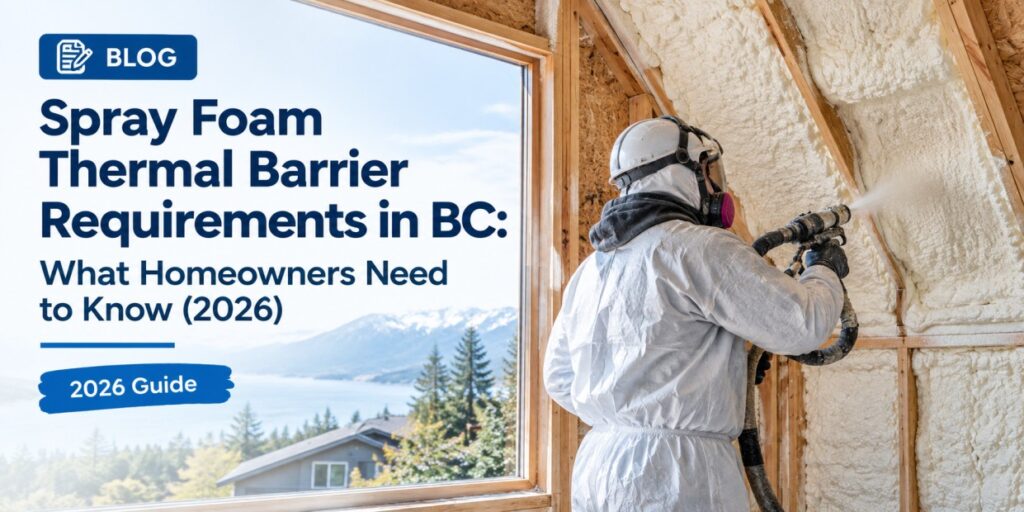
Spray Foam Thermal Barrier Requirements in BC: What Homeowners Need to Know (2026)
Spray Foam Thermal Barrier Requirements in BC: What Homeowners Need to Know (2026) Quick answer: A spray foam thermal barrier is a fire-resistant covering installed over spray polyurethane foam (SPF) to slow the foam’s exposure to heat during a fire. In British Columbia, the building code generally requires foamed plastic insulation, including spray foam, to be covered by an approved thermal barrier such as ½-inch (12.7 mm) gypsum drywall. It can’t be left exposed in occupied spaces. Spray foam is one of the best insulation products for BC homes. It seals air leaks, resists moisture, and delivers high R-value in tight spaces. But one detail catches homeowners, renovators, and even some contractors off guard: spray foam usually can’t be left exposed. If you’re planning to spray foam a basement, garage, crawlspace, rim joist, or attic in Langley, Surrey, Vancouver, or elsewhere in the Lower Mainland, this guide explains what a thermal barrier is, when BC code requires one, which materials qualify, and how to avoid a failed inspection. What Is a Thermal Barrier for Spray Foam? A thermal barrier is a layer of fire-resistant material placed between spray foam insulation and the interior of your home. Its job isn’t to insulate. Its job is to buy time. In a fire, the barrier holds back heat so the foam behind it doesn’t reach ignition temperature as quickly. That delay, measured in minutes under Canadian fire test standards, gives occupants more time to get out and firefighters more time to respond. The most common thermal barrier in BC homes is ordinary ½-inch gypsum drywall, which is why most spray-foamed walls end up drywalled anyway. Why Spray Foam Needs Fire Protection Spray polyurethane foam is a plastic. Like most plastics, it’s combustible. Modern SPF products sold in Canada contain fire retardants and must meet strict standards, including CAN/ULC-S705.1 for the material and CAN/ULC-S705.2 for installation. But fire retardants slow burning. They don’t make foam fireproof. Exposed foam in a fire can: This isn’t a reason to avoid spray foam. It’s a reason to install it correctly. With a proper thermal barrier, spray foam is a safe, code-approved insulation used in thousands of BC homes and commercial buildings every year. Does BC Building Code Require a Thermal Barrier? Yes, in most cases. The BC Building Code (Part 9, housing and small buildings) requires foamed plastic insulation to be protected from the interior of the building. The relevant provision is Article 9.10.17.10, “Protection of Foamed Plastics,” which lists acceptable coverings such as gypsum board, plywood, or tested barrier products. A few things BC homeowners should know: Tip: Ask your spray foam contractor, in writing, how the foam will be protected after installation. If the quote doesn’t mention a thermal barrier and the foam is in a living space, ask why. Thermal Barrier vs. Ignition Barrier vs. Vapour Barrier These three terms get mixed up constantly online, partly because many articles are written for the US market. Thermal Barrier Ignition Barrier Vapour Barrier Purpose Delays heat reaching foam in a fire Delays foam from catching fire Controls moisture movement Protects against Fire (longer protection) Fire (limited protection) Condensation, mould Common materials ½” drywall, plywood/OSB, tested coatings Thin coatings, certain boards 6-mil poly, closed-cell foam Where it’s used Occupied spaces Mainly a US code term for attics and crawlspaces Warm side of insulated walls Used in BC code? Yes, the main requirement Not the usual Canadian term Yes The key point: “Ignition barrier” is mainly a US building code term. If you read an American blog saying a thin coating is all you need in an attic, that doesn’t automatically apply in BC. In Canada, the conversation is usually about thermal barriers and product-specific evaluations. What about vapour barriers? That’s about moisture, not fire. Closed-cell spray foam at sufficient thickness usually acts as its own vapour retarder, which is one reason it works so well in wet West Coast basements and crawlspaces. Our insulation and mould prevention guide explains more. Approved Thermal Barrier Materials These are the materials generally accepted as thermal barriers over foam plastic insulation in BC: Material Typical Requirement Best For Gypsum drywall Minimum ½” (12.7 mm), mechanically fastened Basements, garages, walls, finished spaces Plywood, OSB, or particleboard Minimum 11 mm, joints supported Garages, workshops, utility rooms Sheet metal Code-specified thickness, fastened Commercial and utility areas Concrete or masonry Minimum thickness per code Foundations, commercial builds Plaster Code-specified thickness Some older-home renovations Tested coatings and products Must meet CAN/ULC-S124 (Classification B) or have an approved evaluation Areas where drywall isn’t practical What doesn’t count: Paint, standard house wrap, poly sheeting, fibreglass batts, or cardboard. Covering foam with a vapour barrier and calling it done is a common reason renovations fail inspection. Where You’ll Need a Thermal Barrier: Room-by-Room Guide Basements. If you spray foam basement walls, whether for a suite, rec room, or storage, you’ll almost always need drywall or another approved barrier. Closed-cell foam is popular here because it controls moisture against concrete. Learn more about our basement and crawlspace insulation services. Rim joists. Spray foam is ideal for sealing rim joists, one of the leakiest spots in any home. If the rim joist is in a finished or occupied basement, it needs protection too. Cut drywall pieces or an approved coating are common solutions. Garages and workshops. Many people foam their garage walls and ceiling and want to leave it exposed. Garages are part of the building, so a thermal barrier is typically required. Plywood or OSB is a practical choice if you want something that holds screws for shelving. Crawlspaces. This is where rules get more nuanced. Requirements can depend on whether the crawlspace is accessed only for maintenance, contains fuel-fired equipment such as a furnace or hot water tank, or is used for storage. See our crawlspace insulation guide. Attics and cathedral ceilings. Spray foam applied to the underside of the roof deck (an unvented or “hot roof” assembly) needs a protection strategy that matches how the space is
Spray Foam Thermal Barrier Requirements in BC: What Homeowners Need to Know (2026) Read More »