Insulation R-Value Guide for Langley BC Homeowners: What You Actually Need
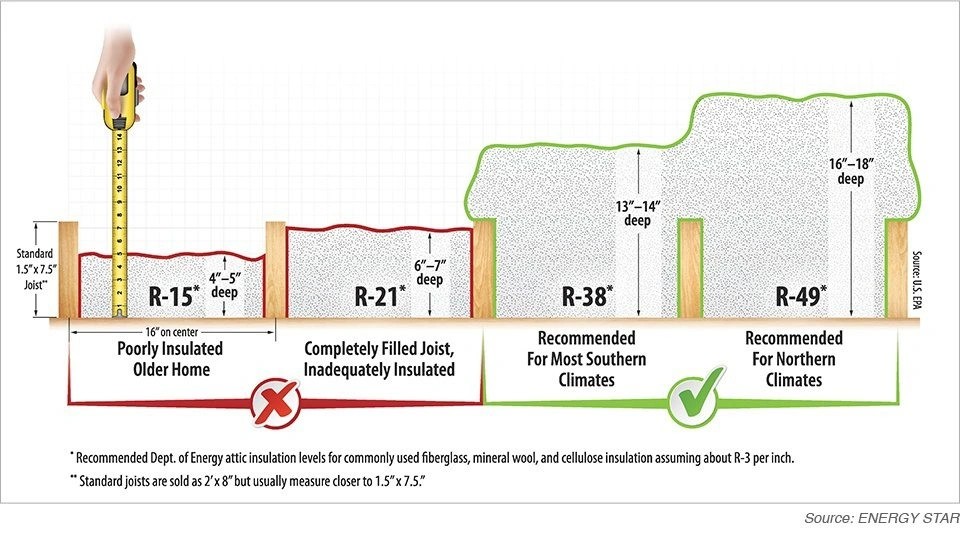
Insulation R-Value Guide for Langley BC Homeowners: What You Actually Need If you’ve been researching insulation for your Langley home, you’ve almost certainly come across the term R-value — and you’ve probably wondered what number you actually need for your attic, your walls, your basement, or your crawlspace. The short answer is that it depends on where in your home you’re insulating. Different parts of your home lose heat in different ways and at different rates, and BC Building Code sets different minimum requirements for each one. The longer answer — and the more useful one — is what this guide covers in full. Understanding R-value before you hire a contractor or purchase materials means you can ask the right questions, evaluate quotes accurately, and make sure the job is done to the standard your Langley home actually needs. What Is R-Value and Why Does It Matter? R-value is a number that measures how well an insulation material resists the flow of heat. The higher the R-value, the more effectively that material slows heat from escaping your home in winter or entering it in summer. Think of it like a winter jacket. A thin cotton jacket might keep you comfortable on a mild day, but in a Langley February — when temperatures are damp and cold and wind is cutting across the Fraser Valley — you need something with real thickness and density. Insulation works the same way. A wall with R-12 might have been adequate when your home was built in the 1980s, but today’s BC Energy Step Code requirements and rising energy costs mean that standard no longer serves you. What makes R-value practically important for Langley homeowners is this: two homes that look identical from the outside can perform very differently depending on the R-values installed in their walls, attic, and foundation. A well-insulated home holds heat efficiently, runs its heating and cooling systems less, and keeps every room at a consistent, comfortable temperature. An under-insulated home fights a losing battle against the cold all winter — and you pay for that difference in your monthly energy bill. R-Value Requirements by Zone: What BC Building Code Requires for Langley Langley falls within BC Climate Zone 4, which covers most of Metro Vancouver and the Fraser Valley. Here is what the BC Building Code currently requires for each zone of your home — and what Western Insulation recommends to meet or exceed those standards for real-world performance. Attic Insulation: R-50 Minimum, R-60 Recommended The attic is where most Langley homes lose the most heat. Hot air rises, and without sufficient insulation in the attic floor, that warmth escapes directly through the roof. BC Building Code requires a minimum of R-40 to R-50 for attic assemblies in Climate Zone 4, but many Langley energy advisors and contractors — including our team at Western Insulation — recommend pushing to R-60 where possible. The difference between R-50 and R-60 may seem incremental on paper, but in practice it closes the gap between code compliance and genuinely high-performing thermal comfort. For most Langley attics, blown-in insulation — either ProPink fibreglass or cellulose — is the most efficient way to achieve R-50 to R-60. It covers every corner, fills irregular joist layouts, and achieves a consistent, seamless layer without gaps. If you’ve never had your attic insulation checked, it’s one of the most valuable free assessments you can book — especially in homes built before 2000, which frequently fall well below current code requirements. Exterior Walls: R-22 to R-24 Effective Exterior walls in Langley require an effective R-value of between R-22 and R-24, depending on your assembly type and local amendments. For a standard 2×6 stud wall, fibreglass or mineral wool batts in the cavity combined with a layer of continuous rigid foam on the exterior is the most common method for reaching this target without thermal bridging through the framing. What is thermal bridging? It is what happens when the wooden studs in your wall conduct heat directly to the outside, bypassing the insulation in the cavity between them. A 2×6 wall filled with R-21 batts does not actually perform at R-21 — it performs closer to R-15 due to bridging losses through the framing. Adding even a thin layer of continuous rigid foam insulation on the exterior breaks that bridge and brings the whole wall assembly up to where it needs to be. Basement Walls: R-20 Minimum Basement walls in Langley need a minimum effective R-value of R-20 under BC code. This is typically achieved with closed-cell spray foam insulation applied directly to the concrete foundation wall, or with rigid foam board panels installed against the wall and covered with a framed assembly. Spray foam is the superior choice for moisture control — it bonds directly to concrete, creates an air and vapour barrier in one step, and does not absorb water the way fibreglass does. If your basement walls are currently uninsulated or insulated with old fibreglass batts that have sagged or compressed, upgrading to a modern system delivers an immediate improvement in floor temperature, energy efficiency, and moisture control. This is covered in more depth in our crawlspace and basement insulation guide for Langley. Crawlspace Walls: R-20 Minimum Crawlspace walls follow similar code requirements to basement walls — R-20 minimum — but the moisture considerations are even more pronounced. An open, damp crawlspace in Langley is one of the most common sources of cold floors, mold growth, and energy loss in the area’s housing stock. Our basement and crawlspace insulation service addresses both the insulation and the vapour barrier, treating the crawlspace as a complete system rather than just a cavity to fill. Interior Walls: No Code Minimum, But Acoustic Matters BC Building Code does not set thermal R-value requirements for interior walls because they do not separate conditioned space from the outdoors. However, if noise control is a priority — which it increasingly is in Langley’s growing strata and multi-family market — mineral wool batt insulation in
Insulation R-Value Guide for Langley BC Homeowners: What You Actually Need Read More »