Attic Insulation

Burnaby Attic Insulation Comfort Guide

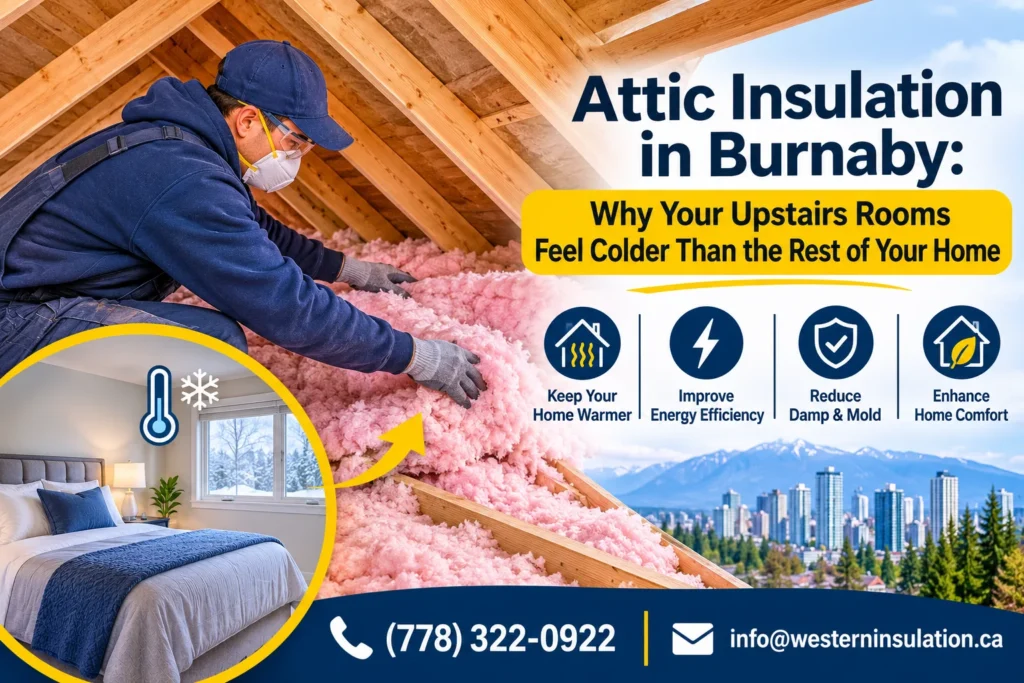
Attic Insulation in Burnaby: Why Your Upstairs Rooms Feel Colder Than the Rest of Your Home

Attic Insulation in Burnaby: Why Your Upstairs Rooms Feel Colder Than the Rest of Your Home During the winter months you may notice that some rooms in your home in Burnaby are colder than others. This may not be due to your heating system itself, but often homes are not well insulated in the attic. This can cause some uncomfortable rooms upstairs, as the heat is escaping through your ceiling. Burnaby is a damp climate, so ensuring your attic is well ventilated and keeping damp to a minimum is key. Having your attic well insulated will help the temperature in your home. Knowing what is happening in your attic will help you determine if you need more insulation, air sealing, or a professional. Why Do Upstairs Rooms Feel Colder in Burnaby Homes? If your attic is not well insulated or has no insulation, you may notice some areas of your attic losing heat. This can cause some rooms to be colder than others, especially if you have a multi-story home. Common reasons: A professional can help you determine if you need more insulation, air sealing or improvements. How Does Attic Insulation Improve Home Comfort? Having your attic well insulated will improve the thermal efficiency of your home and roof. During the colder months it will help keep the heat in your property, and during the summer it will reduce heat transfer. This will ensure your home is at a good temperature in Burnaby. It will also improve your heating efficiency and make your bedroom more comfortable. Depending on your attic and ventilation, we can provide a range of insulation types. Blown Fibre Glass, Batt or Air Sealing. We can send a qualified Attic Insulation Contractor to help advise. When Should You Consider Attic Insulation Removal? Sometimes adding extra insulation may not be the best option. If your insulation is damp, dirty, compressed, or has had pests, you may want to remove it. Signs that your insulation may need removing; Removing damaged insulation allows the attic to be inspected properly before new materials are installed. You can also read our related guide on attic insulation removal and replacement in Langley to understand when replacement may be more suitable than a simple top-up. How to Find the Right Attic Insulation Contractor in Burnaby A quick online search for attic insulation near me should give you a few options to help improve your attic. Ensure they; Why Burnaby Homeowners Should Not Ignore Attic Problems Burnaby can be a very damp and cold place during the winter. If your attic isn’t well insulated or ventilated, it can cause damp issues. If you are noticing damp or mould on your insulation, it is important to understand why there is moisture there. For more information, please see our insulation & mold prevention guide. If your insulation is in good condition but not covering enough, please see our attic insulation top-up guide. Get Professional Attic Insulation in Burnaby If you are having issues with temperature differences, high energy bills, and damaged insulation, we can send a professional to help determine if you need more insulation, air sealing, or removal. We provide professional insulation throughout Burnaby & the Lower Mainland. Please see our attic insulation service page or call us on (778) 322-0922. Email us on info@westerninsulation.ca. Frequently Asked Questions Why Are Some Rooms Colder? Uneven insulation, air loss, ventilation issues, or heating problems can cause some rooms to be colder. A professional can help. How Will I Know If I Need More Insulation In My Attic? If you are having issues with cold rooms upstairs, draughts, high heating bills, and uneven insulation, then your attic may need some work. Should I Remove My Old Insulation? It depends. If your insulation is dry, clean, and in good condition, you may be able to add more insulation. If your insulation is damp, dirty or has had pests then you may need it removed professionally. How Do I Find Attic Insulation Near Me In Burnaby? Find a local contractor who has experience. They should visit your attic to check ventilation and air loss and give clear recommendations. How Long Does It Take To Fit Attic Insulation? Most residential jobs can be completed in a day. How long it takes depends on how big your attic is, how accessible it is, how much insulation you have, and if there is any preparation/removal required.
Attic Insulation in Burnaby: Why Your Upstairs Rooms Feel Colder Than the Rest of Your Home Read More »

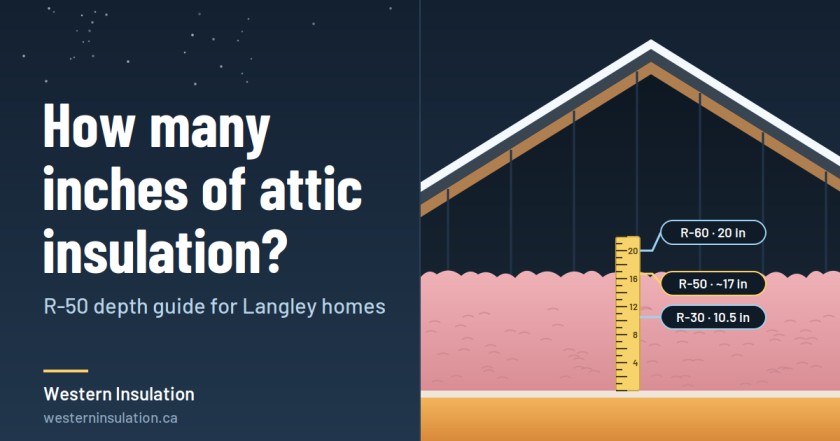
Attic insulation depth ruler showing R-30 at 10.5 inches, R-50 at about 17 inches and R-60 at 20 inches in a Langley home

How Many Inches of Attic Insulation Do You Need? R-50 Depth Guide for Langley Homes

How Many Inches of Attic Insulation Do You Need? R-50 Depth Guide for Langley Homes Quick answer: For a Langley or Lower Mainland attic, aim for about R-50. With blown-in fibreglass, that is roughly 16 to 18 inches of insulation, depending on the product. R-60 is about 20 inches. If you can see the tops of your ceiling joists, you likely have less than R-20 and would benefit from a top-up. Most homeowners never measure their attic insulation. They notice cold upstairs rooms, high heating bills or frost in the attic, but have no idea how much insulation is actually up there. Checking the depth is the easiest way to find out whether your attic is doing its job. This guide explains how many inches of insulation equal each R-value, what Langley homes need, how to measure your attic, and how depth affects your BC Hydro rebate. Attic Insulation Depth Chart The depth needed for each R-value depends on the material. Loose-fill fibreglass, cellulose and batts all have different R-values per inch. This chart uses Owens Corning ProPink L77 loose-fill fibreglass, a common attic product, as a reference. R-value Minimum installed thickness (ProPink L77 loose-fill) Bags per 1,000 sq ft R-30 10.5 inches 13.0 R-38 13.25 inches 16.7 R-44 15 inches 19.7 R-49 16.75 inches 22.2 R-60 20 inches 28.0 Other products differ slightly. Older or lower-grade loose-fill may need more depth for the same R-value, while dense batts may need less. Always check the coverage chart printed on the bag of the product being installed. Quick reference for other materials Material Approx. R per inch Depth for about R-50 Blown-in fibreglass About R-2.9 to R-3.0 About 16 to 18 inches Blown-in cellulose About R-3.2 to R-3.8 About 14 to 16 inches Fibreglass batts About R-3 to R-4 Several layers, often cross-laid Closed-cell spray foam About R-6 About 8 inches (rarely used for open attics) What R-Value Does a Langley Attic Need? For most Langley and Lower Mainland homes, R-50 is a sensible target for attic insulation. It balances comfort, energy savings and cost, and it’s a common recommendation for BC homes being upgraded. Many homes built in the 1980s and 1990s in Walnut Grove, Murrayville and the City of Langley started with less, and decades of settling have reduced it further. It’s common to find attics with only R-12 to R-20 left, which is roughly 4 to 7 inches of old fibreglass. R-60 adds a little more protection and makes sense if your attic has room and the extra cost is small. Going beyond that gives less benefit for each extra inch. New homes follow the BC Building Code and the BC Energy Step Code, so targets for new construction are set by the designer and your municipality. How to Measure Your Attic Insulation You can check your attic in about five minutes: Safety note: If you see grey-brown, pebble-like insulation instead of fluffy fibres, it may be vermiculite. Don’t disturb it. Have it tested for asbestos first. Why Depth Alone Isn’t the Whole Story A deep layer of insulation doesn’t help much if warm air is leaking straight through it. Before adding depth, three things matter: Air sealing Pot lights, the attic hatch, plumbing stacks and gaps around wiring let warm, moist air into the attic. That air carries heat past the insulation and can cause frost and condensation on the roof deck. Sealing these leaks before adding insulation is essential. Our guide to air sealing your home explains where leaks usually hide. Even coverage Insulation needs to be the same depth everywhere. Thin spots near the eaves, around the hatch or where people have walked through the attic lower the overall performance. Ventilation As insulation gets deeper, it can block soffit vents. Baffles keep an air channel open between the insulation and the roof deck, so the attic can breathe. Blocked vents can lead to moisture problems, including attic condensation in winter. How Much Insulation Do You Need to Add? Here’s a simple way to estimate what a top-up involves: Example: a typical Walnut Grove attic Item Value Attic area 1,000 sq ft Existing insulation About 4 inches (about R-12) Target R-50 R-value to add R-38 New insulation About 13 inches of blown-in fibreglass Typical install time One day Most Langley attic top-ups are completed in a single day with blown-in insulation. Learn more about blown-in insulation. Depth and Your BC Hydro Rebate BC Hydro and FortisBC insulation rebates are based on R-value added, not total depth. The attic rebate is calculated as: $0.02 × R-value added × square feet, up to $900 (minimum R-12 added) Using the example above: The work must be done by a Home Performance Contractor Network (HPCN) member, and the invoice must show the starting and final R-value, the insulation type and the square footage. See the full rules on our BC insulation rebates page. Common Depth Mistakes Get the Right Depth the First Time Knowing how many inches of insulation your attic needs is the first step to a warmer, more efficient home. For most Langley homes, that means about 16 to 18 inches of blown-in fibreglass for R-50, installed evenly over a sealed attic floor with clear ventilation. Western Insulation measures existing insulation, seals air leaks, installs baffles and blows in insulation to the right depth, with depth markers so you can see the result. Learn more about our attic insulation services in Langley and the Lower Mainland. Book a free attic insulation assessment Frequently Asked Questions How many inches of insulation is R-50? With blown-in fibreglass, R-50 is roughly 16 to 18 inches, depending on the product. For example, Owens Corning ProPink L77 loose-fill reaches R-49 at a minimum of 16.75 inches. Always check the coverage chart on the bag of the product being used, since depths vary between brands. How many inches is R-60 attic insulation? R-60 with blown-in fibreglass is about 20 inches. Owens Corning ProPink L77 lists a minimum installed thickness of 20 inches for

How Many Inches of Attic Insulation Do You Need? R-50 Depth Guide for Langley Homes Read More »

attic air sealing around a pot light in a Langley home

Air Sealing Your Langley Home: How to Stop Winter Drafts at the Source

Air Sealing Your Langley Home: How to Stop Winter Drafts at the Source Quick answer: Air sealing means closing the gaps and cracks that let heated air escape and cold air leak into your home, around pot lights, attic hatches, plumbing and wiring holes, rim joists, windows and doors. In Langley homes, the biggest leaks are usually at the top of the house, in the attic floor. Sealing them before you add insulation reduces drafts, lowers heating bills and helps prevent winter attic condensation. You’ve turned the thermostat up, but the house still feels drafty. There’s a cold breeze near the baseboards, the upstairs bedroom never quite warms up, and the furnace or heat pump seems to run all day. In many Langley homes, the problem isn’t a lack of heat. It’s air escaping through hundreds of small gaps you can’t see. This guide explains where those leaks hide, why sealing them comes before adding insulation, and what a professional air sealing job in a Langley home involves. What Is Air Sealing? Insulation slows heat moving through your walls and ceilings. Air sealing stops air moving through gaps. They are two different jobs. Think of insulation as a wool sweater and air sealing as a windbreaker. A thick sweater keeps you warm on a still day, but on a windy day the cold cuts right through it. Add a windbreaker and the sweater works the way it should. Your house is the same: insulation full of air leaks performs far below its rated R-value. Why Your House Feels Draftiest in Winter Warm air rises. In winter, heated air pushes up and out through gaps in your ceiling and attic floor. As it escapes at the top, cold outside air is pulled in at the bottom, through gaps around rim joists, baseboards, crawlspace openings and outlets. Building scientists call this the stack effect. The colder it gets outside, the stronger the effect. That’s why a Langley home that feels fine in October can feel drafty during a January cold snap. The air escaping into the attic also carries moisture, which can condense on the cold roof deck. That’s one of the main causes of attic condensation in winter. Where Air Leaks Hide in Langley Homes Langley’s housing ranges from 1980s and 1990s Walnut Grove homes to older Brookswood and Fort Langley houses and newer Willoughby builds. The leak points are similar in all of them, but older homes usually have more. Top of the house (the biggest leaks) Bottom of the house In between Because hot air leaves at the top, the attic floor is usually the most important place to start. Air sealing research consistently ranks attic leaks as the biggest contributor to air leakage for the effort involved. Air Sealing vs. Insulation: Why You Need Both Air Sealing Insulation What it stops Air moving through gaps Heat moving through materials Main benefit Fewer drafts, less moisture in the attic Slower heat loss, warmer surfaces Typical materials Spray foam, caulk, gaskets, weatherstripping, rigid blocking Blown-in fibreglass, batts, spray foam, rigid foam When to do it Before insulating After sealing Rebate on its own? No Yes, based on R-value added The order matters. Once new insulation is blown into an attic, the gaps underneath are buried and much harder to reach. That’s why air sealing is done first, then the attic insulation goes on top. How Professionals Air Seal a Home A professional attic air sealing job in a Langley home typically looks like this: DIY Air Sealing: What You Can Do Yourself Some air sealing is a good weekend project: Leave the attic floor, chimneys, pot lights and anything involving old loose-fill insulation to a professional. Moving through an attic can damage ceilings, and some older Langley homes have vermiculite, which should be tested before anyone disturbs it. Don’t Forget Ventilation A tighter house holds onto moisture and indoor air pollutants as well as heat, so ventilation matters. The goal is to seal unintended leaks and control ventilation on purpose. Does Air Sealing Qualify for BC Rebates? Not on its own. BC Hydro and FortisBC insulation rebates are based on the R-value of insulation added, so air sealing by itself doesn’t earn a rebate. But it’s part of doing insulation properly. Rebated insulation must be installed by a Home Performance Contractor Network (HPCN) member following the Best Practice Guide for Air Sealing and Insulation Retrofits. In practice, air sealing your attic before a top-up makes the rebated insulation work better. Attic insulation currently earns $0.02 × R-value added × square feet, up to $900. See current rules on our insulation rebates page. Stop the Drafts Before the Next Cold Snap Air sealing is one of the most cost-effective comfort upgrades for a Langley home. It reduces drafts, helps your insulation perform as rated, and lowers the risk of winter attic moisture. Paired with an attic top-up, it’s often the single biggest improvement a home can get in one day. Western Insulation air seals and insulates homes across Langley, Surrey, Abbotsford and the Lower Mainland. For more winter prep, see our winter home insulation guide and our crawl space vapour barrier guide. Book a free air sealing and insulation assessment Frequently Asked Questions What is air sealing in a house? Air sealing is closing the gaps, cracks and holes that let air leak in and out of a home, around pot lights, attic hatches, plumbing and wiring holes, rim joists, windows and doors. It stops drafts and the loss of heated air, and helps insulation perform at its rated R-value. It’s usually done right before adding insulation. Should I air seal before adding insulation? Yes. Once new insulation is blown into the attic, the gaps underneath are buried and much harder to reach. Sealing the attic floor first stops warm, moist air from leaking into the attic, which improves comfort, reduces heat loss and helps prevent winter frost and condensation on the roof deck. Where are the biggest air leaks

Air Sealing Your Langley Home: How to Stop Winter Drafts at the Source Read More »

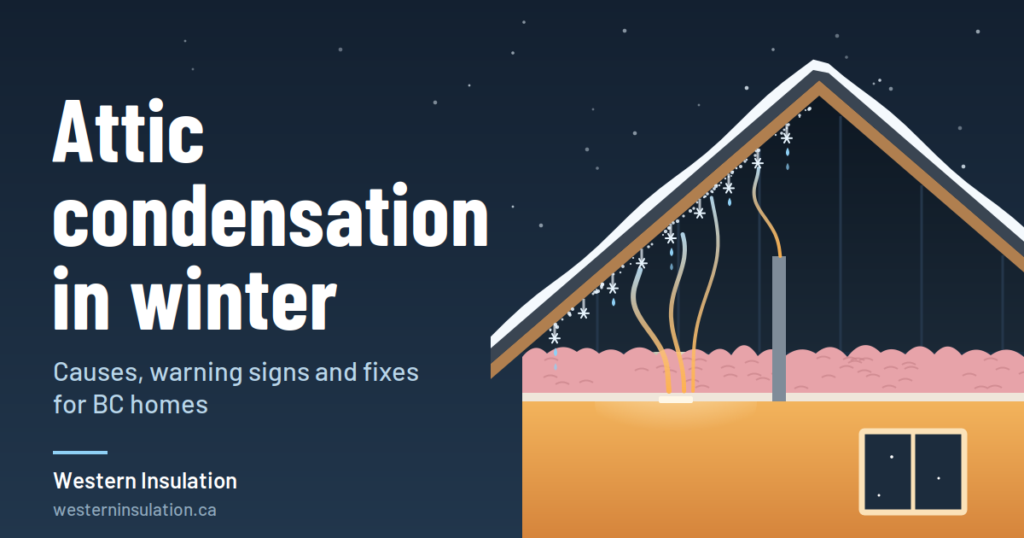
Attic condensation in winter: warm air leaking into a BC attic and forming frost on roofing nails

Attic Condensation in Winter: Causes, Warning Signs & How to Fix It in BC Homes

Attic Condensation in Winter: Causes, Warning Signs & How to Fix It in BC Homes Quick answer: Attic condensation happens when warm, moist air from your living space leaks into a cold attic and turns into water or frost on the roof sheathing, nails, and insulation. In Lower Mainland homes, the main causes are air leaks through the ceiling, bathroom fans venting into the attic, and blocked soffit vents. The lasting fix is to seal air leaks first, then restore ventilation, then top up or replace the insulation, in that order. Winter in Metro Vancouver and the Fraser Valley isn’t usually brutally cold. It’s long, wet, and grey, with temperatures hovering just above freezing for weeks and a few sharp cold snaps in between. That combination makes attic condensation one of the most common hidden problems in BC homes. Most homeowners don’t find out until something goes wrong: a brown stain on the bedroom ceiling, a musty smell, or black spots on the roof boards spotted during a renovation. By then, the moisture may have been building for several winters. This guide explains what causes attic condensation, how to check your own attic in five minutes, and the correct order to fix it so the problem doesn’t come back. What Is Attic Condensation? Attic condensation is moisture that forms on cold surfaces inside your attic. It works like the water droplets on a cold glass on a warm day. In winter, your home is warm and full of moisture from showers, cooking, laundry, and even breathing. A typical family adds several litres of water vapour to indoor air every day. When that warm, humid air finds its way into a cold attic, it hits the underside of the roof deck and the tips of roofing nails, cools down, and releases its moisture as water. On colder nights, it freezes as frost. A little moisture that dries out quickly isn’t a disaster. The problem is repeated wetting, night after night and winter after winter, without enough time to dry. Why Lower Mainland Attics Are at Higher Risk People often assume attic frost is a prairie problem. In some ways, our climate is just as hard on attics: 7 Warning Signs of Attic Condensation You don’t need to be a contractor to spot most of these. Grab a flashlight and look from the attic hatch on a cold morning. If you spot two or more of these, it’s time for a professional attic inspection. Our article on signs your home needs new insulation covers other red flags. The Main Causes of Moisture in Your Attic 1. Air leaks from the living space (the number one cause) In most homes, warm air escapes into the attic through gaps in the ceiling, not through the insulation itself. Common leak points include: Because these leaks are usually hidden under insulation, many homeowners never know they’re there. 2. Bathroom and kitchen fans venting into the attic This is one of the most common problems we find. A bathroom fan that dumps moist air into the attic, or a duct that has disconnected or sagged, pumps water directly where you don’t want it. Every fan should be ducted all the way to the outdoors, and the duct should be insulated. 3. Blocked soffit vents When insulation is blown or pushed into the eaves without baffles, it can block the soffit vents. Without fresh intake air, moisture has nowhere to go. Attic baffles keep a clear air channel between the insulation and the roof deck. 4. Not enough (or damaged) insulation Thin, compressed, or patchy insulation lets more heat into the attic. That warm air carries more moisture and creates uneven hot and cold spots on the roof deck, which encourages condensation and ice dams. 5. High indoor humidity In winter, indoor humidity in the 30 to 50 percent range is a reasonable target for most homes. Drying laundry indoors, long showers without a fan, a broken HRV, or a lot of houseplants can push it higher. Condensation vs. Roof Leak: How to Tell Clue Likely Condensation Likely Roof Leak When it appears After cold nights or when a cold snap ends During or right after heavy rain Where Spread across large areas, often the north slope One spot, often near chimneys, vents, or valleys Nails Frost or rust on many nail tips Usually limited to the wet area Insulation Damp across a wide area Soaked in one localized spot Who to call Insulation and air sealing contractor Roofer Sometimes it’s both. If you’re not sure, an attic inspection can sort it out before you pay for the wrong repair. How to Fix Attic Condensation (in the Right Order) The order matters. Many homeowners add more insulation first, and the problem comes back. Here’s the sequence that works. Step 1: Fix the moisture sources Make sure every bathroom, kitchen, and dryer fan vents to the outdoors through a sealed, insulated duct. Repair any disconnected ducts in the attic. Run bathroom fans during showers and for 20 to 30 minutes after. Step 2: Air seal the attic floor This is the most important step and the one most often skipped. Seal pot lights (using insulation-contact-rated fixtures or approved covers), plumbing stacks, wire penetrations, top plates, chimney chases, and the attic hatch. Professionals often use spray foam insulation and sealants to close these gaps permanently. Step 3: Restore ventilation Install or replace baffles at the eaves so soffit vents stay open, and make sure there’s balanced intake and exhaust. If ventilation needs major roof work, such as new ridge vents, coordinate with a roofer. Step 4: Remove wet, mouldy, or contaminated insulation If your insulation has been soaked, compressed, or contaminated by mould or pests, adding new insulation on top just traps the problem. Professional insulation removal with industrial vacuum equipment clears the attic so the air sealing can be done properly. Learn more about attic insulation removal and replacement. Step 5: Insulate to the right R-value Once the

Attic Condensation in Winter: Causes, Warning Signs & How to Fix It in BC Homes Read More »

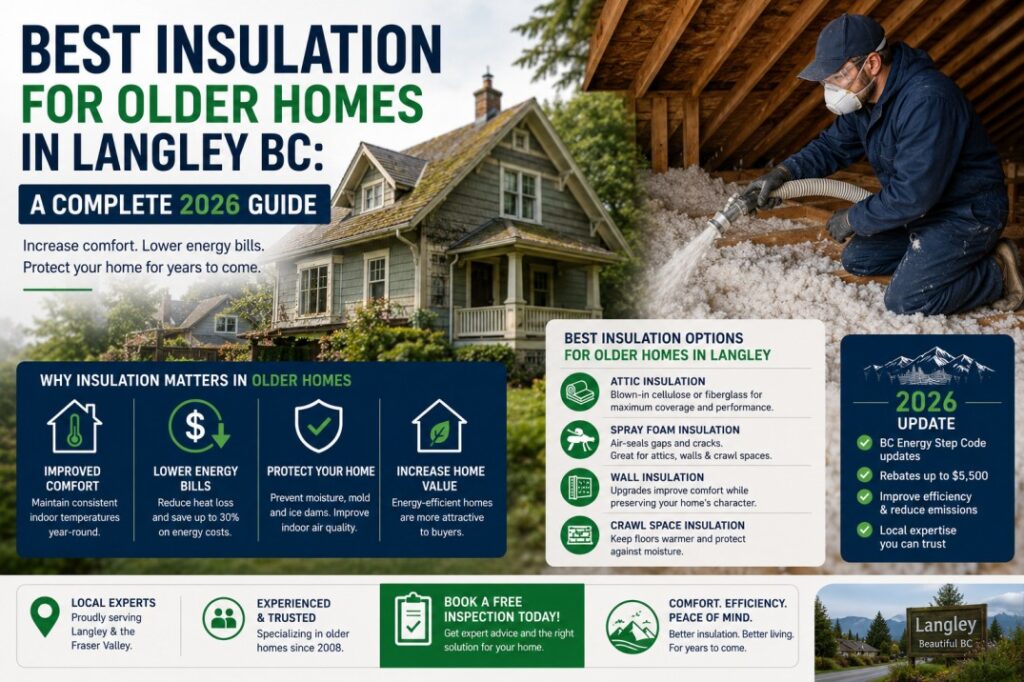
Best Insulation for Older Homes in Langley BC: A Complete 2026 Guide

Best Insulation for Older Homes in Langley BC: A Complete 2026 Guide

Best Insulation for Older Homes in Langley BC: A Complete 2026 Guide The short answer: For most older homes in Langley BC, the best insulation combination is blown-in fibreglass to R-60 in the attic with air sealing included, closed-cell spray foam in the crawlspace and rim joists, and dense-pack blown-in in closed exterior wall cavities. The correct approach in each zone depends on your home’s construction era — and the starting point that matters most is knowing what you already have. Langley’s residential housing stock spans more than six decades of construction history — from post-war bungalows in Murrayville and Aldergrove to 1970s ranch-style homes in Brookswood, 1980s developments in Walnut Grove, and 1990s builds in Willoughby. Each era has its own insulation profile — its own materials, its own installation standards, and its own specific failure modes that develop over time in BC’s damp climate. If you own an older home in Langley and you are trying to understand what insulation you currently have, what you actually need, and what the best upgrade path looks like for your specific home, this guide gives you the honest, era-specific answers. Why Older Homes in Langley BC Lose More Heat — and Why It Matters Now Older homes in Langley lose significantly more heat than current building science considers acceptable — not because they were poorly built by the standards of their time, but because those standards have changed dramatically. The BC Building Code R-value requirements that apply to Langley homes today are substantially higher than anything that was required when most of the Fraser Valley’s existing housing stock was constructed. The practical consequence is that a 1985 Langley home is spending considerably more on heating every month than a modern home of equivalent size — and most of that difference is not the heating system, it is the insulation. Every dollar spent heating that home is fighting a losing battle against heat loss through an attic that should be at R-60 but sits at R-20, a crawlspace with no insulation at all, and 2×4 walls with original R-12 batts that have settled and compressed over 40 years. The better news is that the solutions are well understood, the materials are excellent, BC Hydro and FortisBC rebates of up to $5,500 offset a significant portion of the cost, and the payback period on a properly executed insulation upgrade in an older Langley home is typically three to five years before rebates and considerably shorter after. Insulation by Era: What Your Langley Home Has and What It Needs Pre-1977 Langley Homes — The Highest Priority Cases Langley homes built before 1977 represent the most significant insulation deficiency in the Fraser Valley housing stock — and they are the cases where a proper upgrade delivers the most dramatic improvement. What these homes typically have: What they need: In the attic, blown-in fibreglass insulation from near-zero to R-60 is the single highest-impact upgrade available to a pre-1977 Langley home. Air sealing of every ceiling bypass location before the blown-in goes in is essential — because these homes were built with no consideration for airtightness, and the gap between a properly sealed ceiling and an unsealed one in a pre-1977 home is among the largest in the housing stock. For the walls, dense-pack blown-in insulation through small drilled access holes is the most practical approach for bringing near-empty 2×4 cavities to R-13 without demolition. For a pre-1977 Langley home with no wall insulation, this upgrade delivers immediate and dramatic improvement in wall surface temperature, draft reduction, and room-to-room comfort. For the crawlspace, closed-cell spray foam on crawlspace walls and rim joists combined with a code-compliant vapour barrier across the crawlspace floor is the complete system approach — addressing thermal loss, moisture, and the cold floor conditions that are endemic in this housing era. 1977–1990 Langley Homes — Below Code, But Not Empty The late 1970s through the 1980s represent the most common construction era in Langley — and these homes typically have some insulation but nowhere near enough by current standards. What these homes typically have: What they need: The attic is almost always the starting point for 1977–1990 Langley homes. An existing attic at R-12 to R-20 is a strong candidate for a top-up to R-60 — adding blown-in fibreglass over the existing material without removal, provided the existing insulation is dry, free of mold, and free of pest contamination. Our detailed guide on attic insulation top up in Langley BC covers exactly how to assess whether a top-up or full replacement is correct for your specific attic. For 1977–1990 crawlspaces with fibreglass batts in floor joists, replacement with spray foam on the crawlspace walls is the recommended approach rather than adding to the floor joist batts. As we covered in the insulation and mold prevention guide for Langley BC, fibreglass batts in Fraser Valley crawlspaces absorb ground moisture over time and hold it against floor joists — a problem that spray foam on the walls, combined with a vapour barrier on the floor, eliminates at the source. For the walls, the original R-12 batts in 2×4 framing have typically settled to less than R-9 in real-world conditions after 35 to 45 years of service. A dense-pack blown-in top-up through small access holes can restore full cavity density and bring the assembly back to R-13 to R-15 — a meaningful improvement over the current settled state, at a cost and disruption level that is accessible for most Langley homeowners. 1990–2000 Langley Homes — Closer But Still Short Langley homes built in the 1990s are closer to current standards but still fall short of what is now required — and the specific deficiencies are more targeted than in earlier eras. What these homes typically have: What they need: For 1990s Langley homes, the attic top-up from R-20 to R-32 up to R-60 remains the highest-priority upgrade — and it is also the most straightforward and cost-effective, because the existing insulation in most 1990s attics is

Best Insulation for Older Homes in Langley BC: A Complete 2026 Guide Read More »

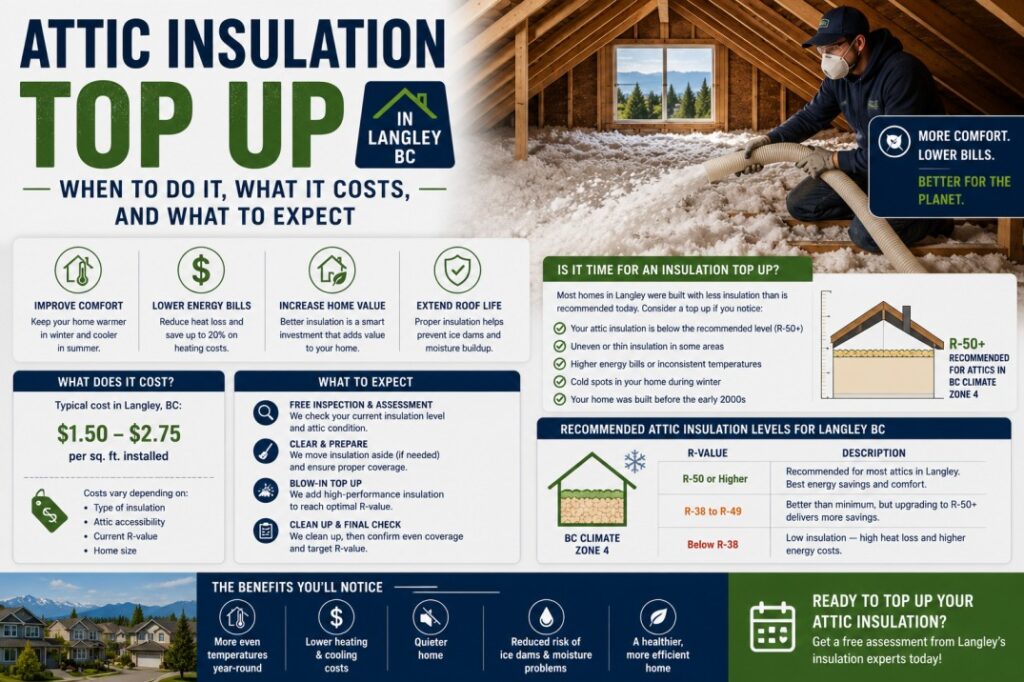
Attic Insulation Top Up in Langley BC: When to Do It, What It Costs, and What to Expect

Attic Insulation Top Up in Langley BC: When to Do It, What It Costs, and What to Expect

Attic Insulation Top Up in Langley BC: When to Do It, What It Costs, and What to Expect The short answer: An attic insulation top up is the right move when your existing insulation is structurally sound but below the R-50 to R-60 target recommended for Langley homes in BC Climate Zone 4. If your insulation is mold-contaminated, pest-damaged, or made from old compressed fibreglass, a full removal and replacement is the correct approach instead. Most Langley attic top-up projects cost $1,500 to $3,500 and qualify for BC Hydro and FortisBC rebates of up to $1,200. If you have been searching for information about topping up your attic insulation in Langley and finding answers that are either too vague or too US-focused to be useful, this guide is for you. It covers every question homeowners ask before booking an attic insulation top up — from how to know if topping up is right for your specific attic to exactly what the process looks like from start to finish. What Is an Attic Insulation Top Up? An attic insulation top up means adding new blown-in insulation on top of your existing attic insulation to increase the total R-value to the level your home needs. It is not a replacement — the existing insulation stays in place, and new material is blown in over it to build the total depth up to the target. This is the most common attic insulation project in Langley homes built between 1980 and 2010. These homes were typically insulated to the standard of the time — R-20 to R-32 — which was code-compliant when they were built but falls well short of what BC Building Code now requires and what experienced Langley insulation contractors recommend for real-world energy performance in the Fraser Valley climate. A properly executed top up brings the attic from wherever it currently sits to R-50, R-60, or beyond, depending on your goals and the BC rebate program you are targeting. And because existing insulation that is in good condition contributes to the final total, you are only paying for the additional material needed to reach the target — not a complete reinstall from scratch. Top Up vs Full Replacement: How to Know Which One You Need This is the question that matters most before any attic insulation project in Langley — and the answer depends on the condition of your existing insulation, not just its depth. A top up is the right choice when: Your existing insulation is dry, free of mold, and free of pest contamination. It may be compressed and settled below its original depth — that is normal for insulation of any age — but it is otherwise structurally sound and not a health or moisture risk. In this case, adding blown-in insulation on top of it is the most cost-effective path to R-50 or R-60, because the existing material still contributes meaningful R-value and does not need to come out first. Most Langley homes with fibreglass batts or blown-in fibreglass from the 1990s or early 2000s fall into this category, provided the home has not had a moisture problem, pest infestation, or roof leak that affected the attic space. A full removal and replacement is the right choice when: Your existing insulation is wet, mold-affected, or contaminated by rodents, squirrels, or other pests. Adding new blown-in on top of contaminated material does not fix the contamination — it buries it, and the underlying problem continues to develop. Our dedicated guide to attic insulation removal and replacement in Langley covers this process in full. Vermiculite insulation — a grey, granular material found in some pre-1990 Langley homes — may also need to be professionally assessed and in some cases removed before new insulation is installed, because it may contain asbestos. If you are unsure whether your existing attic insulation contains vermiculite, a professional inspection before any work proceeds is essential. The insulation removal service from Western Insulation handles all contaminated material safely, with industrial vacuum equipment, proper disposal, and a clean attic inspection before new blown-in insulation is installed. What Does an Attic Insulation Top Up Actually Involve? A professional attic insulation top up in Langley is not simply blowing more material in and calling it done. A properly executed top up includes several steps that determine whether the upgrade actually delivers the energy savings it is supposed to. Step 1 — Attic Inspection Before any material goes in, a trained inspector assesses your attic. This involves checking the existing insulation type and depth to determine your current R-value, identifying any moisture staining, mold, or pest evidence that would change the approach, locating and measuring air bypass locations — the gaps around light fixtures, plumbing penetrations, and wall top plates that allow warm air to escape from your living space into the attic — and confirming attic ventilation is functioning correctly. Step 2 — Air Sealing This is the step that separates a high-performing attic upgrade from a mediocre one — and it is the step most commonly skipped by less experienced contractors. Every air bypass location identified in the inspection is physically sealed using spray foam or acoustic sealant before any new insulation is installed. This matters because warm interior air escaping through those gaps bypasses the insulation entirely, reducing the real-world performance of your attic regardless of how much insulation sits above those gaps. Homes that receive air sealing alongside insulation upgrades achieve energy savings of 25 to 40% on heating costs. Homes that receive only additional insulation without air sealing typically achieve 10 to 15%. The difference is not the insulation material — it is whether the bypasses were closed first. This is why Western Insulation includes air sealing as a standard component of every attic insulation project in Langley. Step 3 — Blown-In Insulation Installation Once air sealing is complete, blown-in fibreglass insulation — typically ProPink by Owens Corning — is machine-applied over the existing insulation to the target depth. ProPink is a GREENGUARD

Attic Insulation Top Up in Langley BC: When to Do It, What It Costs, and What to Expect Read More »

Insulation R-Value Guide for Langley BC Homeowners: What You Actually Need

Insulation R-Value Guide for Langley BC Homeowners: What You Actually Need If you’ve been researching insulation for your Langley home, you’ve almost certainly come across the term R-value — and you’ve probably wondered what number you actually need for your attic, your walls, your basement, or your crawlspace. The short answer is that it depends on where in your home you’re insulating. Different parts of your home lose heat in different ways and at different rates, and BC Building Code sets different minimum requirements for each one. The longer answer — and the more useful one — is what this guide covers in full. Understanding R-value before you hire a contractor or purchase materials means you can ask the right questions, evaluate quotes accurately, and make sure the job is done to the standard your Langley home actually needs. What Is R-Value and Why Does It Matter? R-value is a number that measures how well an insulation material resists the flow of heat. The higher the R-value, the more effectively that material slows heat from escaping your home in winter or entering it in summer. Think of it like a winter jacket. A thin cotton jacket might keep you comfortable on a mild day, but in a Langley February — when temperatures are damp and cold and wind is cutting across the Fraser Valley — you need something with real thickness and density. Insulation works the same way. A wall with R-12 might have been adequate when your home was built in the 1980s, but today’s BC Energy Step Code requirements and rising energy costs mean that standard no longer serves you. What makes R-value practically important for Langley homeowners is this: two homes that look identical from the outside can perform very differently depending on the R-values installed in their walls, attic, and foundation. A well-insulated home holds heat efficiently, runs its heating and cooling systems less, and keeps every room at a consistent, comfortable temperature. An under-insulated home fights a losing battle against the cold all winter — and you pay for that difference in your monthly energy bill. R-Value Requirements by Zone: What BC Building Code Requires for Langley Langley falls within BC Climate Zone 4, which covers most of Metro Vancouver and the Fraser Valley. Here is what the BC Building Code currently requires for each zone of your home — and what Western Insulation recommends to meet or exceed those standards for real-world performance. Attic Insulation: R-50 Minimum, R-60 Recommended The attic is where most Langley homes lose the most heat. Hot air rises, and without sufficient insulation in the attic floor, that warmth escapes directly through the roof. BC Building Code requires a minimum of R-40 to R-50 for attic assemblies in Climate Zone 4, but many Langley energy advisors and contractors — including our team at Western Insulation — recommend pushing to R-60 where possible. The difference between R-50 and R-60 may seem incremental on paper, but in practice it closes the gap between code compliance and genuinely high-performing thermal comfort. For most Langley attics, blown-in insulation — either ProPink fibreglass or cellulose — is the most efficient way to achieve R-50 to R-60. It covers every corner, fills irregular joist layouts, and achieves a consistent, seamless layer without gaps. If you’ve never had your attic insulation checked, it’s one of the most valuable free assessments you can book — especially in homes built before 2000, which frequently fall well below current code requirements. Exterior Walls: R-22 to R-24 Effective Exterior walls in Langley require an effective R-value of between R-22 and R-24, depending on your assembly type and local amendments. For a standard 2×6 stud wall, fibreglass or mineral wool batts in the cavity combined with a layer of continuous rigid foam on the exterior is the most common method for reaching this target without thermal bridging through the framing. What is thermal bridging? It is what happens when the wooden studs in your wall conduct heat directly to the outside, bypassing the insulation in the cavity between them. A 2×6 wall filled with R-21 batts does not actually perform at R-21 — it performs closer to R-15 due to bridging losses through the framing. Adding even a thin layer of continuous rigid foam insulation on the exterior breaks that bridge and brings the whole wall assembly up to where it needs to be. Basement Walls: R-20 Minimum Basement walls in Langley need a minimum effective R-value of R-20 under BC code. This is typically achieved with closed-cell spray foam insulation applied directly to the concrete foundation wall, or with rigid foam board panels installed against the wall and covered with a framed assembly. Spray foam is the superior choice for moisture control — it bonds directly to concrete, creates an air and vapour barrier in one step, and does not absorb water the way fibreglass does. If your basement walls are currently uninsulated or insulated with old fibreglass batts that have sagged or compressed, upgrading to a modern system delivers an immediate improvement in floor temperature, energy efficiency, and moisture control. This is covered in more depth in our crawlspace and basement insulation guide for Langley. Crawlspace Walls: R-20 Minimum Crawlspace walls follow similar code requirements to basement walls — R-20 minimum — but the moisture considerations are even more pronounced. An open, damp crawlspace in Langley is one of the most common sources of cold floors, mold growth, and energy loss in the area’s housing stock. Our basement and crawlspace insulation service addresses both the insulation and the vapour barrier, treating the crawlspace as a complete system rather than just a cavity to fill. Interior Walls: No Code Minimum, But Acoustic Matters BC Building Code does not set thermal R-value requirements for interior walls because they do not separate conditioned space from the outdoors. However, if noise control is a priority — which it increasingly is in Langley’s growing strata and multi-family market — mineral wool batt insulation in

Insulation R-Value Guide for Langley BC Homeowners: What You Actually Need Read More »

Attic insulation contractor installing insulation between roof rafters in Langley BC home

When to Replace Your Attic Insulation in Langley: Signs, Process & Costs

When to Replace Your Attic Insulation in Langley: Signs, Process & Costs Most Langley homeowners think about adding attic insulation — but far fewer think about removing the old stuff first. If your home was built before 2000, the insulation currently sitting in your attic may be doing more harm than good. It could be compressed, moisture-damaged, contaminated with mold, or simply too thin to meet today’s energy standards. Knowing when to replace (not just top up) your attic insulation is one of the most important home maintenance decisions you can make in the Fraser Valley’s damp, variable climate. In this guide, we walk you through the clear warning signs, what the removal and replacement process actually looks like, what it costs, and how to make the most of the BC rebates available to Langley homeowners. 5 Signs Your Langley Attic Insulation Needs to Be Replaced (Not Just Topped Up) Adding new insulation on top of old, damaged material is a common mistake. Here’s when a full removal and replacement is the right call: 1. You Can See Moisture, Staining, or Mold Langley’s wet winters push moisture into attic spaces. Once insulation gets wet, it loses its R-value immediately and becomes a breeding ground for mold. Wet batt insulation in particular clumps and sags, leaving gaps where heat escapes freely. If you spot dark staining, musty odours, or visible mold, a professional insulation removal is essential before any new material goes in. 2. Your Home Has Vermiculite or Old Fibreglass Batts Homes built before the 1990s may contain vermiculite insulation, which can be associated with asbestos contamination. Even if it isn’t vermiculite, old fibreglass batts from the 1980s and 90s have often settled to a fraction of their original depth and no longer provide meaningful resistance. Topping up over degraded material gives you a false sense of security without the performance. 3. You’ve Had a Rodent or Pest Problem Mice, squirrels, and other pests frequently nest in attic insulation, contaminating it with droppings and urine. No amount of new insulation fixes a hygiene problem underneath. Full vacuum removal is the only solution, and it protects your family’s air quality long term. 4. Your Energy Bills Keep Climbing If your heating and cooling costs are rising year over year despite no change in usage habits, your attic is likely the culprit. As we’ve covered in our complete guide to attic insulation in Langley, a well-insulated attic can cut energy costs by 20–30%. When old insulation is the barrier to those savings, replacement — not addition — unlocks the full benefit. 5. You’re Planning a Major Renovation If you’re re-roofing, adding HVAC equipment, or converting attic space, it makes sense to start fresh with new, properly installed insulation rather than working around deteriorated existing material. What Does the Attic Insulation Removal Process Look Like? Many homeowners are surprised to learn that professional attic insulation removal is a clean, fast, and minimally disruptive process when done properly. Here’s what to expect when you book a removal and replacement with Western Insulation in Langley: Step 1 – Attic Inspection Our team inspects your attic to assess insulation condition, identify any moisture damage, pest evidence, or air sealing issues, and determine the best removal approach for your home’s layout. Step 2 – Vacuum Removal We use industrial-grade insulation vacuum equipment to remove all existing material safely. The insulation is bagged and disposed of properly off-site. This step also gives us access to the attic floor to seal any bypasses — the small gaps around wires, pipes, and fixtures that allow conditioned air to escape regardless of how much insulation sits above them. Step 3 – Air Sealing This is where significant energy savings are actually won. Before any new insulation goes in, our installers seal all attic bypasses with spray foam or caulking. This step is often skipped by less experienced contractors, but it makes a measurable difference to your home’s thermal performance. Step 4 – New Insulation Installation Depending on your home and goals, we install the most appropriate material — commonly blown-in insulation such as ProPink® fibreglass or cellulose, which covers irregular spaces evenly and achieves the high R-values required by BC building code. For certain applications, batt insulation or rigid foam boards may also be part of the solution. Step 5 – Final Check and Documentation We verify R-value coverage, confirm ventilation is unobstructed, and provide documentation for your records — including what you need for rebate applications. How Much Does Attic Insulation Removal and Replacement Cost in Langley? Costs vary based on attic size, insulation type, and condition of the existing material. As a general guide: The good news? Current BC Hydro and FortisBC programs mean eligible Langley homeowners can access up to $5,500 in rebates on qualifying insulation upgrades. Our team handles all the paperwork — you don’t need to navigate the program requirements on your own. Learn more on our rebates page. Blown-In vs. Batt: Which Is Better for Langley Attic Replacement? After removal, most Langley homes benefit most from blown-in insulation — either cellulose or fibreglass. Blown-in material fills every corner and gap without cutting or fitting around obstructions, making it ideal for the irregular joist layouts common in older Fraser Valley homes. It also achieves higher R-values per inch and settles less over time than older batt products. That said, every attic is different. Our home insulation team in Langley will assess your specific attic and recommend the right product for your goals and budget — not just the easiest option to install. Why Work With a Local Langley Insulation Contractor? Not all insulation companies understand the specific challenges of Langley’s climate — the persistent winter humidity, the temperature swings between seasons, and the ventilation requirements that prevent moisture buildup in a tightly sealed attic. Local experience matters. At Western Insulation, we’ve worked on hundreds of homes across Langley and the Fraser Valley. We understand local building codes, we’re familiar with the home styles and construction

When to Replace Your Attic Insulation in Langley: Signs, Process & Costs Read More »

Attic of a building with wooden beams of a roof structure.

How Attic Insulation Can Transform Your Langley Home’s Comfort and Efficiency

How Attic Insulation Can Transform Your Langley Home’s Comfort and Efficiency Imagine a home where every corner is warm during the icy chill of winter and refreshingly cool in the summer’s peak. Sounds perfect, doesn’t it? That’s not a dream but a reality you can achieve with the right attic insulation. In Langley, where temperatures can swing dramatically, your home’s comfort and efficiency can be significantly enhanced by focusing on this often-overlooked area. Attic insulation might not be the first thing you think of when upgrading your home, but it has the potential to transform your living space entirely. Ever wondered why your energy bills skyrocket during the winter months despite your best efforts to conserve heat? Key Takeaways Understanding the Importance of Attic Insulation Attic insulation is more than just a layer of material; it acts as a barrier between your home and the external environment. During the colder months, it keeps the warmth generated by your heating system from escaping through the roof. Conversely, in the summer, it prevents the searing heat from seeping into your living space. In essence, attic insulation is crucial for maintaining a consistent indoor temperature all year round. A well-insulated attic can significantly reduce your heating costs. By minimising the amount of heat that escapes in winter, your heating system doesn’t have to work as hard, leading to lower energy bills. It’s a straightforward equation: the better your home retains heat, the less energy you need to maintain a comfortable temperature. This is especially important in Langley, where winters can be harsh. But it’s not just about saving money. Proper attic insulation also helps prevent moisture build-up. Moisture can lead to a host of problems, from mould growth to structural damage. By effectively insulating your attic, you create a barrier that prevents warm air from meeting cold surfaces, where condensation can occur. Comfort is another key aspect that attic insulation addresses. A well-insulated attic ensures that your home remains at a stable temperature, eliminating cold drafts and hot spots. Everyone loves a cosy home, and insulation plays a pivotal role in achieving that comfort level. Finally, improving your home’s energy efficiency is a wise investment. Not only does it enhance insulation performance, but it also contributes to a more sustainable environment. With rising energy costs, making your home more efficient is both economically and environmentally beneficial. Types of Insulation for Your Attic Choosing the right type of insulation for your attic can be a game-changer. Each option offers distinct advantages, tailored to fit various needs and preferences. Let’s dive into the most popular types and explore their unique benefits. Fibreglass insulation, often found in the form of batts or rolls, is a popular choice for many homeowners. Known for its affordability and effectiveness, it provides excellent thermal insulation while being relatively easy to install. Fibreglass batts are particularly useful for covering large areas and can be a DIY project for those who enjoy tackling home improvements themselves. Cellulose insulation, made from recycled paper products, stands out for its eco-friendly properties. It’s treated to resist fire and pests, making it a safe and sustainable choice. Blown-in attic insulation is a common method for installing cellulose, allowing it to fill in gaps and crevices effectively, enhancing air sealing capabilities. Spray foam insulation is another option, providing superior air sealing and insulating properties. It expands upon application, filling every nook and cranny, thus creating an airtight barrier that significantly reduces energy loss. While it can be more expensive, the energy savings over time can justify the initial investment. Mineral wool insulation is known for its excellent fire-resistant qualities. It’s made from volcanic rock and recycled steel slag, offering both thermal and sound insulation. This type of insulation is ideal for homeowners who prioritise safety and noise reduction. Each insulation type has its considerations, so it’s essential to weigh the pros and cons based on your specific needs. Whether you’re interested in eco-friendly materials or prioritising air sealing, there’s an insulation option tailored to your requirements. How Proper Attic Insulation Boosts Energy Efficiency One of the most compelling reasons to insulate your attic is the boost in energy efficiency it provides. Proper insulation minimises heat loss during the colder months, keeping your home warmer without over-relying on your heating system. This translates directly to lower energy bills, a welcome relief for any homeowner. Improved insulation efficiency doesn’t just lower costs; it enhances the performance of your HVAC system. When your home retains heat better, the heating system doesn’t have to work as hard, prolonging its lifespan and reducing maintenance needs. It’s a win-win situation that benefits both your wallet and your home’s infrastructure. Consistent indoor temperatures are another significant advantage. Proper attic insulation means fewer fluctuations in your home’s temperature, leading to increased comfort. It’s not just about warmth in winter; the same principle applies in summer, where insulation helps keep your home cool. Homeowners who invest in quality insulation often notice a difference in their energy consumption quickly. The initial investment may seem steep, but the long-term savings and improved comfort levels make it an attractive proposition. Exploring Eco-Friendly Insulation Options In today’s world, many homeowners are leaning towards sustainable solutions, and insulation is no exception. Eco-friendly insulation options not only reduce your carbon footprint but often come with additional benefits like energy-saving rebates. Cellulose insulation is a standout eco-friendly option. Made from recycled materials, it offers excellent thermal and sound insulation properties. It’s an environmentally conscious choice that doesn’t compromise on performance. Sheep’s wool insulation provides natural and sustainable benefits. It’s a renewable resource with excellent thermal properties and is biodegradable, making it a top choice for eco-conscious homeowners. Cork insulation is another renewable option, known for its exceptional thermal properties. It’s harvested without harming the tree, making it a sustainable choice. Plus, cork is naturally resistant to moisture and pests. Choosing sustainable materials for your insulation not only reflects a commitment to the environment but can also be financially rewarding. Many regions offer

How Attic Insulation Can Transform Your Langley Home’s Comfort and Efficiency Read More »

attic insulation Langley

The Complete Guide to Attic Insulation in Langley, BC: What Homeowners Need to Know in 2025

The Complete Guide to Attic Insulation in Langley, BC: What Homeowners Need to Know in 2026 If you own a home in Langley and your energy bills keep climbing no matter what you do, the problem is very likely sitting right above your head. The attic is the single biggest source of heat loss in a typical BC home — yet it’s also the most overlooked. In this guide, the team at Western Insulation walks you through everything you need to know about attic insulation in Langley: from the warning signs that your home is under-insulated, to the types of insulation that work best in the Fraser Valley climate, to the government rebates that can cut your project cost dramatically. Why Attic Insulation Matters So Much for Langley Homes Langley sits in the heart of the Fraser Valley, where winters bring sustained cold and damp, and summers can push well above 30°C. That combination puts enormous pressure on your home’s thermal envelope — the barrier between conditioned indoor air and the outdoors. When attic insulation is thin, old, or damaged, heat escapes through your ceiling all winter long, and your air conditioning fights a losing battle all summer. The numbers make the case clearly. Heating and cooling account for up to 65% of the average Canadian household’s energy bill. Studies consistently show that a properly insulated attic can reduce those costs by 20–30%. For a Langley household spending $250/month on heating, that is real money — potentially $600 or more back in your pocket every year. Beyond the bill, poor attic insulation causes real comfort problems: cold floors above unheated garages, rooms that never quite warm up in January, stuffy bedrooms in August, and drafts that no amount of weatherstripping seems to fix. These are all signs that your attic is letting your HVAC system work far harder than it should. 5 Warning Signs Your Langley Home Needs Attic Insulation Not sure whether your attic insulation needs attention? Here are the five most common red flags we encounter when inspecting Langley homes: 1. Energy bills are rising year over year. If your gas or hydro bills have been creeping up even though your usage habits haven’t changed, thermal loss through the attic is often the culprit. 2. Rooms feel uneven — some too hot, some too cold. Inconsistent temperatures throughout your home indicate that conditioned air is escaping before it reaches where it’s needed. 3. Your insulation depth is less than 13 inches. BC Building Code targets a minimum R-50 for attic spaces in the Lower Mainland. If your existing insulation is visibly thin or compressed, it almost certainly falls short. 4. You see moisture, staining, or mold in the attic. Inadequate insulation combined with poor ventilation creates condensation that leads to mold growth, rot, and long-term structural damage. 5. Ice dams formed on your roof last winter. Ice dams are a classic sign that heat is escaping through the attic, melting snow near the roof ridge, which then refreezes at the cold eaves. Proper insulation and ventilation solve this directly. If any of these apply to your home, the smartest next step is a free attic inspection — something Western Insulation provides at no charge across Langley and surrounding communities. Attic Insulation Options for Langley Homeowners Not all insulation is the same, and the right choice depends on your attic’s current condition, your budget, and your long-term goals. Here are the main options we install for Langley homeowners: Blown-In Fiberglass Insulation This is the most popular choice for attic retrofits — and for good reason. Blown-in insulation is machine-applied, meaning it fills every irregular corner, joist cavity, and hard-to-reach area of your attic space. It creates a seamless, uniform thermal blanket that batt insulation simply cannot replicate. For Langley’s older housing stock, blown-in is often the gold standard solution because it upgrades an existing attic to R-50 without major disruption. Most jobs are completed in a single day with minimal mess. Batt Insulation Premium fiberglass or mineral wool batts are well-suited to accessible attic areas with standard joist spacing. Batt insulation delivers consistent R-values and adds a degree of soundproofing as a bonus. When properly cut, fitted, and combined with air sealing, batts perform very well — especially in new construction or straightforward attic layouts. Spray Foam Attic Insulation Spray foam does double duty as both insulation and air sealing, making it particularly effective for cathedral ceilings, complex roof lines, and areas prone to drafts. It expands to fill every gap and sets rigid, creating a durable seal that lasts decades. While spray foam typically costs more per square foot than other options, many Langley homeowners find the energy performance and total air-tightness more than justify the investment over the life of the home. Air Sealing This is often the missing piece in older Langley homes. You can have plenty of insulation, but if warm air is bypassing it through gaps around light fixtures, pipes, or attic hatches, your energy performance suffers dramatically. Professional air sealing, done before or alongside new insulation, closes those bypasses and makes every layer of insulation work harder. Attic Insulation Removal and Replacement in Langley Sometimes the right move is not to add insulation on top of existing material — it’s to remove it first. Our attic insulation removal service in Langley is recommended when: Western Insulation handles complete attic insulation removal and replacement as a single, managed process. We take care of everything — safe extraction, disposal, any necessary remediation, and full reinstallation to current R-50 standards — so you are not coordinating multiple contractors. BC Attic Insulation Rebates: What Langley Homeowners Qualify For This is where the picture gets genuinely exciting for 2025. Provincial and utility rebate programs in BC have made attic insulation upgrades remarkably affordable. Through BC Hydro, FortisBC, and CleanBC programs, eligible Langley homeowners can currently access: The paperwork and eligibility requirements can be confusing — but that is exactly where Western Insulation’s team adds real value. We

The Complete Guide to Attic Insulation in Langley, BC: What Homeowners Need to Know in 2025 Read More »