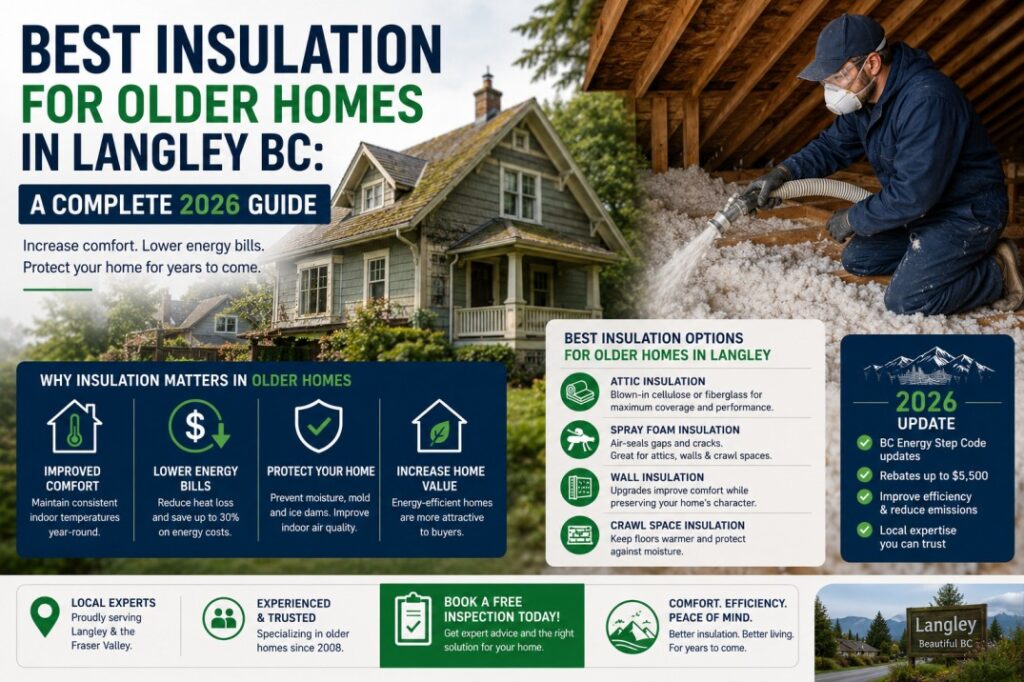
Best Insulation for Older Homes in Langley BC: A Complete 2026 Guide
The short answer: For most older homes in Langley BC, the best insulation combination is blown-in fibreglass to R-60 in the attic with air sealing included, closed-cell spray foam in the crawlspace and rim joists, and dense-pack blown-in in closed exterior wall cavities. The correct approach in each zone depends on your home’s construction era — and the starting point that matters most is knowing what you already have.
Langley’s residential housing stock spans more than six decades of construction history — from post-war bungalows in Murrayville and Aldergrove to 1970s ranch-style homes in Brookswood, 1980s developments in Walnut Grove, and 1990s builds in Willoughby. Each era has its own insulation profile — its own materials, its own installation standards, and its own specific failure modes that develop over time in BC’s damp climate.
If you own an older home in Langley and you are trying to understand what insulation you currently have, what you actually need, and what the best upgrade path looks like for your specific home, this guide gives you the honest, era-specific answers.
Why Older Homes in Langley BC Lose More Heat — and Why It Matters Now
Older homes in Langley lose significantly more heat than current building science considers acceptable — not because they were poorly built by the standards of their time, but because those standards have changed dramatically. The BC Building Code R-value requirements that apply to Langley homes today are substantially higher than anything that was required when most of the Fraser Valley’s existing housing stock was constructed.
The practical consequence is that a 1985 Langley home is spending considerably more on heating every month than a modern home of equivalent size — and most of that difference is not the heating system, it is the insulation. Every dollar spent heating that home is fighting a losing battle against heat loss through an attic that should be at R-60 but sits at R-20, a crawlspace with no insulation at all, and 2×4 walls with original R-12 batts that have settled and compressed over 40 years.
The better news is that the solutions are well understood, the materials are excellent, BC Hydro and FortisBC rebates of up to $5,500 offset a significant portion of the cost, and the payback period on a properly executed insulation upgrade in an older Langley home is typically three to five years before rebates and considerably shorter after.
Insulation by Era: What Your Langley Home Has and What It Needs
Pre-1977 Langley Homes — The Highest Priority Cases
Langley homes built before 1977 represent the most significant insulation deficiency in the Fraser Valley housing stock — and they are the cases where a proper upgrade delivers the most dramatic improvement.
What these homes typically have:
- Attic: empty or R-8 to R-11 fibreglass batts from original construction
- Walls: 2×4 framing with no insulation in the cavity at all, or minimal early fibreglass that has long since settled to nothing
- Crawlspace: completely open, no insulation, no vapour barrier
- Basement walls: bare concrete, no insulation
What they need: In the attic, blown-in fibreglass insulation from near-zero to R-60 is the single highest-impact upgrade available to a pre-1977 Langley home. Air sealing of every ceiling bypass location before the blown-in goes in is essential — because these homes were built with no consideration for airtightness, and the gap between a properly sealed ceiling and an unsealed one in a pre-1977 home is among the largest in the housing stock.
For the walls, dense-pack blown-in insulation through small drilled access holes is the most practical approach for bringing near-empty 2×4 cavities to R-13 without demolition. For a pre-1977 Langley home with no wall insulation, this upgrade delivers immediate and dramatic improvement in wall surface temperature, draft reduction, and room-to-room comfort.
For the crawlspace, closed-cell spray foam on crawlspace walls and rim joists combined with a code-compliant vapour barrier across the crawlspace floor is the complete system approach — addressing thermal loss, moisture, and the cold floor conditions that are endemic in this housing era.
1977–1990 Langley Homes — Below Code, But Not Empty
The late 1970s through the 1980s represent the most common construction era in Langley — and these homes typically have some insulation but nowhere near enough by current standards.
What these homes typically have:
- Attic: R-12 to R-20 blown-in or batt fibreglass, often from original construction, compressed and settled
- Walls: R-12 fibreglass batts in 2×4 framing — code-compliant at the time, well below current effective R-22 to R-24 requirement
- Crawlspace: fibreglass batts in floor joists in some cases, or no insulation — rarely a proper vapour barrier
- Basement: R-8 to R-12 in some homes, often fibreglass that has compressed or absorbed moisture
What they need: The attic is almost always the starting point for 1977–1990 Langley homes. An existing attic at R-12 to R-20 is a strong candidate for a top-up to R-60 — adding blown-in fibreglass over the existing material without removal, provided the existing insulation is dry, free of mold, and free of pest contamination. Our detailed guide on attic insulation top up in Langley BC covers exactly how to assess whether a top-up or full replacement is correct for your specific attic.
For 1977–1990 crawlspaces with fibreglass batts in floor joists, replacement with spray foam on the crawlspace walls is the recommended approach rather than adding to the floor joist batts. As we covered in the insulation and mold prevention guide for Langley BC, fibreglass batts in Fraser Valley crawlspaces absorb ground moisture over time and hold it against floor joists — a problem that spray foam on the walls, combined with a vapour barrier on the floor, eliminates at the source.
For the walls, the original R-12 batts in 2×4 framing have typically settled to less than R-9 in real-world conditions after 35 to 45 years of service. A dense-pack blown-in top-up through small access holes can restore full cavity density and bring the assembly back to R-13 to R-15 — a meaningful improvement over the current settled state, at a cost and disruption level that is accessible for most Langley homeowners.
1990–2000 Langley Homes — Closer But Still Short
Langley homes built in the 1990s are closer to current standards but still fall short of what is now required — and the specific deficiencies are more targeted than in earlier eras.
What these homes typically have:
- Attic: R-20 to R-32 blown-in or batt fibreglass — the most common starting point for 1990s Fraser Valley homes
- Walls: R-12 to R-19 fibreglass batts in 2×4 or 2×6 framing — closer to code minimums of the time
- Crawlspace: varying conditions — some have vapour barriers, many have fibreglass in floor joists rather than spray foam on walls
- Basement: R-12 to R-20 in some homes, depending on finished vs unfinished status
What they need: For 1990s Langley homes, the attic top-up from R-20 to R-32 up to R-60 remains the highest-priority upgrade — and it is also the most straightforward and cost-effective, because the existing insulation in most 1990s attics is still in adequate condition for a top-up rather than a full replacement.
If walls are 2×6 framing with R-19 batts, the gap to effective R-22 to R-24 is smaller — and in many cases a layer of continuous rigid foam insulation added to the exterior during a siding replacement is the most practical way to close that gap without opening the interior walls.
The Best Insulation Materials for Older Langley Homes by Zone
Attic: Blown-In Fibreglass
For older Langley homes in every era, blown-in fibreglass is the standard recommendation for attic upgrades. At R-2.5 per inch, it reaches R-60 in a 24-inch layer that covers every irregular surface of the attic floor uniformly. It does not disturb finished ceilings below, can be installed over existing insulation in good condition, and is completed in a single day for most Langley homes.
The critical step that older homes particularly need — and that less experienced contractors sometimes skip — is air sealing before the blown-in goes in. Pre-1990 Langley homes have unsealed ceiling planes full of gaps around light fixtures, wall top plates, and plumbing penetrations that allow warm interior air to escape into the attic above the insulation. Sealing these first is what makes the difference between a 10 to 15% energy saving and a 25 to 40% saving.
Walls: Dense-Pack Blown-In
For older Langley homes where drywall removal is not planned, dense-pack blown-in insulation through small access holes is the most practical wall upgrade. Achieving R-13 to R-15 in a 2×4 cavity or R-20 to R-22 in a 2×6 cavity without drywall removal makes this approach accessible for homeowners who want meaningful wall performance improvement without a major renovation.
For older homes where a renovation is already planned and walls will be opened, combining cavity batt insulation with a layer of continuous rigid foam on the exterior is the highest-performing option — achieving effective R-22 to R-24 and eliminating thermal bridging through the stud framing.
Crawlspace: Closed-Cell Spray Foam + Vapour Barrier
For older Langley homes — particularly pre-1990 homes where the crawlspace may have no insulation at all, or 1980s homes where fibreglass floor joist batts have been absorbing ground moisture for decades — the spray foam crawlspace insulation approach is the most complete and durable solution.
Closed-cell spray foam on crawlspace walls insulates, air-seals, and vapour-controls in a single application. A 10 to 20 mil polyethylene vapour barrier across the crawlspace floor blocks ground moisture from entering the space. The combination eliminates cold floors, moisture risk, and mold conditions in a single properly executed project.
Basement Walls: Spray Foam or Rigid Foam
For older Langley homes with uninsulated concrete basement walls, the choice is between closed-cell spray foam bonded directly to the concrete (the premium option that provides both insulation and vapour control) and rigid foam board against the wall covered with a framed assembly (the cost-effective option for dry basements with controlled moisture conditions).
BC Rebates Available for Older Home Insulation Upgrades in Langley
The Better Homes BC rebate programs currently available to Langley homeowners make 2026 an excellent time to address insulation deficiencies in older homes. BC Hydro and FortisBC offer up to $1,200 for qualifying attic insulation upgrades, up to $1,200 for crawlspace and basement wall insulation reaching R-20, and additional amounts for wall insulation improvements.
Combined across multiple zones in a whole-home project, the total available is up to $5,500. Western Insulation is a certified HPCN partner contractor and manages the complete rebate application process for every qualifying Langley project. Full details are on the BC insulation rebates page.
Getting the Right Assessment for Your Older Langley Home
The most important step before any insulation upgrade in an older Langley home is a professional on-site assessment that confirms what you actually have — not what a home from that era typically has. Every older home is different: some have been partially upgraded, some have had moisture events that have compromised existing insulation, and some have vermiculite or other materials that require specific handling before new insulation is installed.
Western Insulation provides free on-site assessments across Langley, Surrey, Abbotsford, Burnaby, Coquitlam, Mission, Maple Ridge, and Vancouver. We have been insulating Fraser Valley homes since 1998 and have completed insulation upgrades in every construction era represented in Langley’s housing stock.
Our home insulation service covers every zone of your building envelope in a single coordinated project — with BC rebate eligibility confirmed before any work begins and all rebate paperwork managed on your behalf after the project is complete.
Book your free older home insulation assessment in Langley today. Find out exactly what your home has, what it needs, and what it will cost — with full BC rebate support from the Fraser Valley’s #1 rated insulation contractor.