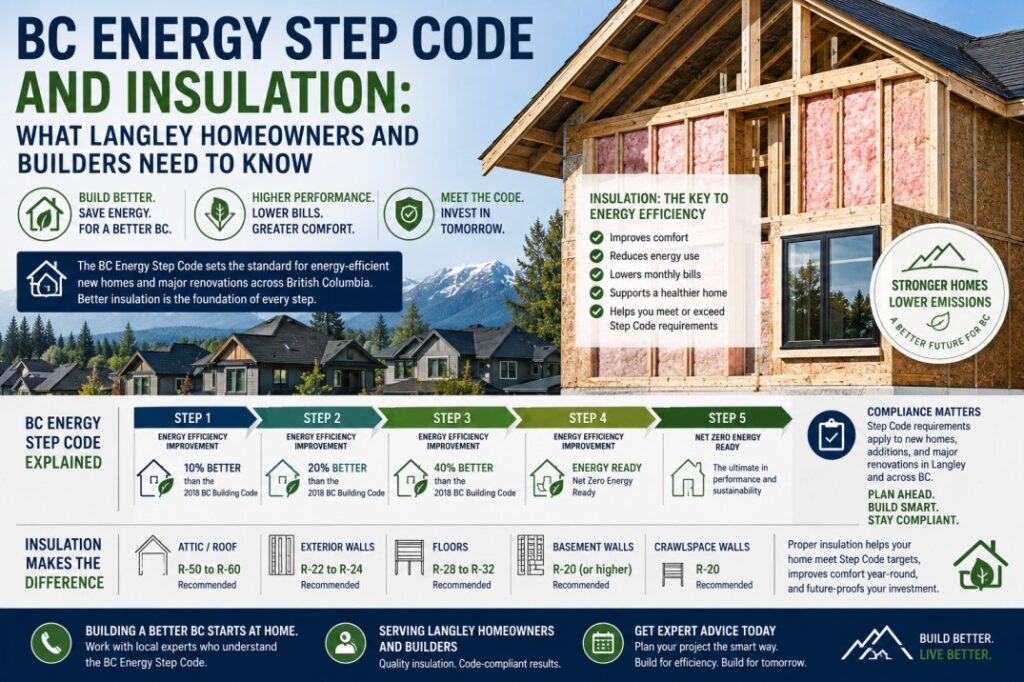
BC Energy Step Code and Insulation: What Langley Homeowners and Builders Need to Know
The short answer: The Township of Langley requires Step 4 under the BC Energy Step Code for all new Part 9 residential construction as of April 1, 2025. This means new Langley homes must meet significantly higher insulation, airtightness, and energy performance standards than the previous minimum BC Building Code required — and it affects how insulation is specified, installed, and documented on every new build and major renovation in the municipality.
If you are building a new home in Langley, planning a significant renovation, or simply trying to understand why insulation requirements seem to have changed since you last dealt with them, this guide explains the BC Energy Step Code in plain language — what it requires, what it means for insulation specifically, and why it matters for existing homeowners as well as new builders.
What Is the BC Energy Step Code?
The BC Energy Step Code is a tiered performance standard that sets progressively higher energy efficiency requirements for new residential and commercial construction in British Columbia. Unlike the previous BC Building Code approach — which set minimum requirements for individual building elements like insulation R-values, window performance, and heating systems — the Step Code sets a whole-building energy performance outcome and allows builders to decide how to achieve it through the combination of materials and design choices that best fits their project.
The Step Code is organised in numbered steps, with Step 1 being the baseline minimum and Step 5 representing near-net-zero energy performance. Steps require a pre-construction energy model developed by a registered Energy Advisor, a mid-construction blower door airtightness test before drywall is installed, and a final as-built compliance report confirming the home performs as designed.
In practical terms, higher Steps require better insulation, better airtightness, better windows, and better mechanical systems — and insulation is the component of the building envelope where achieving Step compliance most often requires deliberate planning and the right contractor.
What Step Does Langley Require in 2026?
The Township of Langley requires Step 4 and Zero Carbon EL-3 for all new Part 9 residential construction — a category that covers most single-family homes and small multi-family buildings — for building permits submitted from April 1, 2025 onward. This is one of the more demanding Step Code requirements in Metro Vancouver and the Fraser Valley, placing Langley alongside municipalities like Vancouver, Richmond, and Burnaby in requiring performance well above the provincial baseline.
Step 4 in the BC Energy Step Code requires an airtightness target of 1.5 air changes per hour or better, measured by a blower door test. Achieving that level of airtightness in a real building is not possible through insulation alone — it requires a coordinated air barrier strategy where every penetration, joint, and transition in the building envelope is deliberately sealed. Insulation and airtightness work together in a Step 4 home: the insulation provides the thermal resistance, and the air barrier prevents warm air from bypassing that resistance through convective movement.
For comparison, the City of Surrey requires Step 3 (2.5 air changes per hour airtightness target), and Abbotsford requires Step 3 with EL-1 for permits after March 2025. The Township of Langley’s Step 4 requirement is a meaningful step up from these surrounding municipalities.
What Does Step 4 Mean for Insulation in a Langley New Build?
Step 4 does not prescribe specific R-values for each zone of a new Langley home — it sets a whole-building energy performance outcome that the design team must model and achieve. However, there are practical insulation specifications that are well-established as the typical approach for achieving Step 4 compliance in Langley’s Climate Zone 4 conditions.
Attic and Roof Assembly
To achieve Step 4 energy performance in Langley, attic insulation in new residential construction typically needs to reach R-50 to R-60 minimum — with many Step 4-compliant designs targeting R-60 or higher. The ceiling or attic floor assembly must be designed as part of the overall air barrier strategy, with every penetration sealed before insulation is installed.
For standard vented attic designs in Langley new builds, blown-in fibreglass insulation is the most practical method for achieving R-50 to R-60 consistently across the full attic floor. For unvented roof assemblies — where the insulation is applied to the underside of the roof decking rather than the attic floor — spray foam insulation is the typical choice, as it provides both the required R-value and the continuous air barrier without a separate air barrier product.
Exterior Walls
Achieving Step 4 energy performance in Langley exterior walls requires exceeding the standard prescriptive minimum. In practice, this typically means either 2×6 framing with R-22 cavity insulation plus a layer of continuous rigid foam insulation on the exterior, or a similar combination that brings the effective wall R-value above R-22 while eliminating thermal bridging through the framing.
Thermal bridging — the phenomenon where heat conducts through structural framing members, bypassing the cavity insulation — is a significant factor in Step 4 compliance. A 2×6 wall with R-22 batt insulation in the cavity performs at approximately effective R-16 when thermal bridging is accounted for. Adding a layer of continuous rigid foam on the exterior breaks the thermal bridge and brings the whole-wall effective R-value up to where Step 4 energy modelling requires it.
Basement and Foundation Walls
In new Langley construction targeting Step 4, basement and foundation walls typically require R-20 or higher in an effective, thermally continuous assembly. Closed-cell spray foam applied directly to foundation walls combined with continuous rigid foam is a common approach — providing both the required R-value and the vapour control needed in BC’s damp climate. The full scope of what Western Insulation provides for basement and crawlspace insulation covers both new construction and retrofit applications.
Airtightness and Air Sealing
Step 4’s 1.5 air changes per hour airtightness target is where many Langley new builds either succeed or fall short — and it is the element most directly dependent on contractor execution rather than material specification. Achieving 1.5 ACH requires that every bypass location in the building envelope be deliberately sealed: top plates, bottom plates, penetrations for electrical, plumbing and mechanical, window and door rough openings, and the attic hatch if one is present.
This is exactly the air sealing work that Western Insulation includes as a standard component of every attic insulation project — regardless of whether the project is new construction or a retrofit. The physics are the same: insulation without air sealing delivers a fraction of the energy performance that a properly sealed and insulated assembly achieves.
Does the BC Energy Step Code Apply to Existing Homes and Renovations?
Step Code compliance is primarily a requirement for new construction building permits. However, it increasingly affects renovation projects as well — and understanding where the line sits matters for Langley homeowners planning significant upgrades.
In general, the BC Energy Step Code applies to renovation projects in Langley when the scope of the project involves disturbance of more than 25% of the building envelope — including exterior walls, the roof assembly, or the foundation. When a renovation reaches this threshold, Step Code compliance requirements may be triggered for the affected envelope components, requiring insulation and airtightness performance above what the original BC Building Code prescriptive minimums specified.
For Langley homeowners planning a re-roofing project combined with attic insulation, an exterior cladding replacement combined with wall insulation, or a major basement renovation, discussing Step Code implications with both the permit office and the insulation contractor at the planning stage — before construction begins — avoids the situation where Step Code compliance is identified as a requirement mid-project.
How Step Code Affects the Value of Insulation Upgrades in Existing Langley Homes
Even for homeowners not undertaking Step Code-triggering renovations, the Step Code’s trajectory matters. By 2032, all new construction in BC must be net-zero energy ready — and the entire residential property market in Langley is moving toward a baseline where energy performance is an expected, documented attribute of every home rather than an optional upgrade.
Homes that already meet or exceed Step 4 insulation and airtightness standards — through properly executed retrofits covering the attic, crawlspace, and wall assemblies — are better positioned for resale in this market than homes still at 1990s insulation levels. A higher EnerGuide home rating, documented completion reports from HPCN-registered contractors, and the energy cost savings that BC rebates help achieve are all tangible assets in the Langley property market of 2026 and beyond.
For a full breakdown of what different insulation upgrades cost in Langley and what BC rebates are available to offset that investment, the 2026 insulation cost guide for Langley BC covers every zone in detail. The insulation R-value guide for Langley homeowners explains what BC Building Code and Step Code require in each zone of your specific home.
Working With an Insulation Contractor Who Understands Step Code in Langley
The difference between an insulation contractor who understands BC Energy Step Code requirements and one who does not is the difference between a project that passes the mid-build blower door test and one that fails — requiring remediation before drywall can be installed.
For new construction in the Township of Langley, Western Insulation works with builders and their Energy Advisors to ensure insulation specification, installation, and documentation all align with Step 4 requirements. That means coordinated air sealing at every bypass location before insulation is installed, materials specified to the R-values needed for the energy model to achieve compliance, and documentation that supports the as-built compliance report.
Western Insulation serves Langley, Surrey, Abbotsford, Burnaby, Coquitlam, Mission, and Vancouver — and provides home insulation services for new builds, major renovations, and retrofit upgrades alike.
Book a free assessment with Western Insulation to discuss your new build insulation requirements, renovation scope, or retrofit upgrade needs — and to confirm which BC rebate programs apply to your specific project.