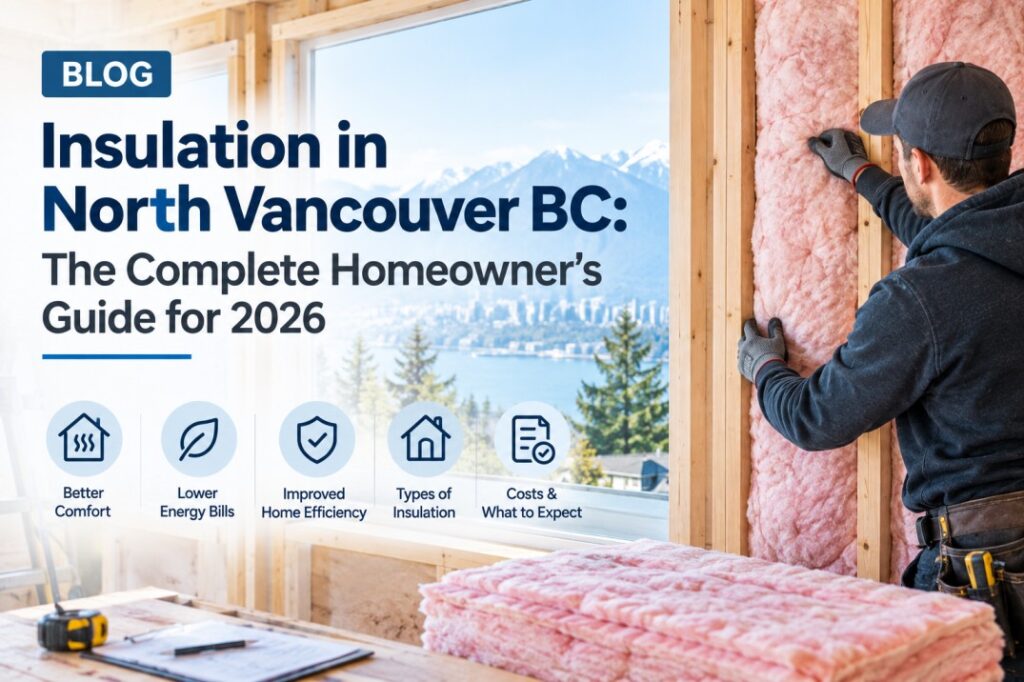
Insulation in North Vancouver BC: The Complete Homeowner’s Guide for 2026
Insulation in North Vancouver BC: The Complete Homeowner’s Guide for 2026 The short answer: North Vancouver homes face insulation challenges that are more demanding than most Metro Vancouver locations — higher annual rainfall, steeper lots that create persistent ground moisture, older Craftsman and post-war housing stock in Lynn Valley, Deep Cove, and Edgemont Village, and a coastal mountain climate that pushes moisture into wall cavities and crawlspaces with more force and frequency than the flatland communities to the south. The best insulation strategy for a North Vancouver home prioritises moisture control alongside thermal performance — and the correct material for each zone reflects both priorities, not just R-value targets. North Vancouver sits at the base of the Coast Mountains, where annual rainfall significantly exceeds the Metro Vancouver average and where the combination of mountain runoff, coastal air, and sustained wet winters creates building envelope conditions that are genuinely different from Surrey, Langley, or Burnaby. Homeowners who treat North Vancouver insulation decisions the same way they would treat a Langley project consistently find that they have underestimated the moisture management component — and pay for it in mold, structural damage, and insulation failure within years rather than decades. This guide is written specifically for North Vancouver homeowners — addressing the North Shore’s particular climate conditions, the housing stock eras most common in North Vancouver neighbourhoods, and the insulation approach that performs correctly in this specific environment. Why North Vancouver Is Different: Climate and Housing Stock North Vancouver’s annual precipitation is among the highest in the Lower Mainland. The North Shore mountains force Pacific storm systems upward, causing orographic rainfall that dumps significantly more moisture on North Vancouver communities than on the flatland communities to the south. Lynn Valley, Deep Cove, Edgemont Village, and the upper reaches of North Vancouver District receive sustained wet conditions through a heating season that runs from October through April — with rain, not just cold, as the defining challenge. This matters for insulation because moisture in BC’s climate is what causes insulation to fail. Fibreglass batts absorb moisture and lose R-value. Poorly vapour-controlled wall assemblies allow warm interior air to condense on cold exterior surfaces. Crawlspaces in steep-lot North Vancouver homes are exposed to ground moisture from multiple directions — the natural slope drives water toward the foundation from above as well as below. Any insulation product or system that does not account for this moisture environment will underperform in North Vancouver — regardless of its R-value specification. The housing stock compounds this challenge. North Vancouver’s residential neighbourhoods include a significant proportion of older homes — post-war bungalows from the 1940s and 1950s in Lower Lynn and Capilano areas, mid-century ranchers from the 1960s and 1970s throughout North Vancouver District, and 1980s construction across a wide band of North Shore communities. Many of these homes have original insulation that has absorbed decades of North Shore moisture, compressed well below its original R-value, and in some cases developed the mold conditions that BC’s damp climate produces when moisture-absorbing insulation is placed in vulnerable locations. Zone-by-Zone Insulation Guide for North Vancouver Homes Attic Insulation in North Vancouver The attic is the highest-priority insulation zone in virtually every North Vancouver home — and the approach is consistent with the rest of Metro Vancouver but with heightened attention to ventilation and moisture management that the North Shore’s rainfall levels demand. What North Vancouver attics need: Most North Vancouver homes built before 2000 have attic insulation sitting at R-20 to R-32 — well below the current BC Building Code minimum of R-40 to R-50 and the R-60 that Western Insulation recommends for optimal performance in Climate Zone 4. An attic insulation upgrade to R-60 using ProPink blown-in fibreglass — with thorough air sealing of every ceiling bypass location before the blown-in goes in — is the standard approach for North Vancouver home upgrades. The North Shore ventilation consideration: In a North Vancouver home with a vented attic assembly, ventilation adequacy is more critical than in drier Metro Vancouver locations. The combination of warm, moist interior air rising through the ceiling and the high ambient outdoor moisture on the North Shore creates a condensation risk on the underside of roof sheathing that is higher than in Burnaby or Surrey. Western Insulation’s attic assessment in North Vancouver confirms both insulation depth and ventilation adequacy — ensuring that the soffit-to-ridge ventilation channel is clear and functioning correctly before any new insulation is installed above it. Attic air sealing in North Vancouver: Air sealing is standard on every attic project Western Insulation completes — including North Vancouver. But in North Shore homes, particularly pre-1980 construction, the ceiling planes are often full of unsealed penetrations that allow warm, moisture-laden interior air to reach the cold attic surface above. Sealing these bypasses before blown-in insulation is installed is what eliminates the condensation risk that causes mold on North Vancouver roof sheathing — a problem seen far more frequently on the North Shore than in lower-rainfall Metro Vancouver communities. For detailed information on the removal process when existing mold or degraded insulation is present in a North Vancouver attic, the insulation removal service guide for BC covers every step. Crawlspace Insulation in North Vancouver Crawlspace insulation is where North Vancouver’s climate diverges most significantly from the rest of Metro Vancouver — and where choosing the wrong material is most likely to create a problem worse than the one being solved. North Vancouver crawlspaces receive ground moisture from two directions: standard upward evaporation from the soil below, and lateral moisture infiltration from sloping lots that channel water toward the foundation. Many North Vancouver homes on steeper lots have crawlspaces that are wetter for longer periods than comparable flat-lot homes in Surrey or Burnaby — and this affects the insulation approach fundamentally. Why fibreglass is wrong for most North Vancouver crawlspaces: Fibreglass batt insulation in floor joists is the most common crawlspace insulation in older North Vancouver homes — and it is consistently the source of the worst moisture
Insulation in North Vancouver BC: The Complete Homeowner’s Guide for 2026 Read More »