
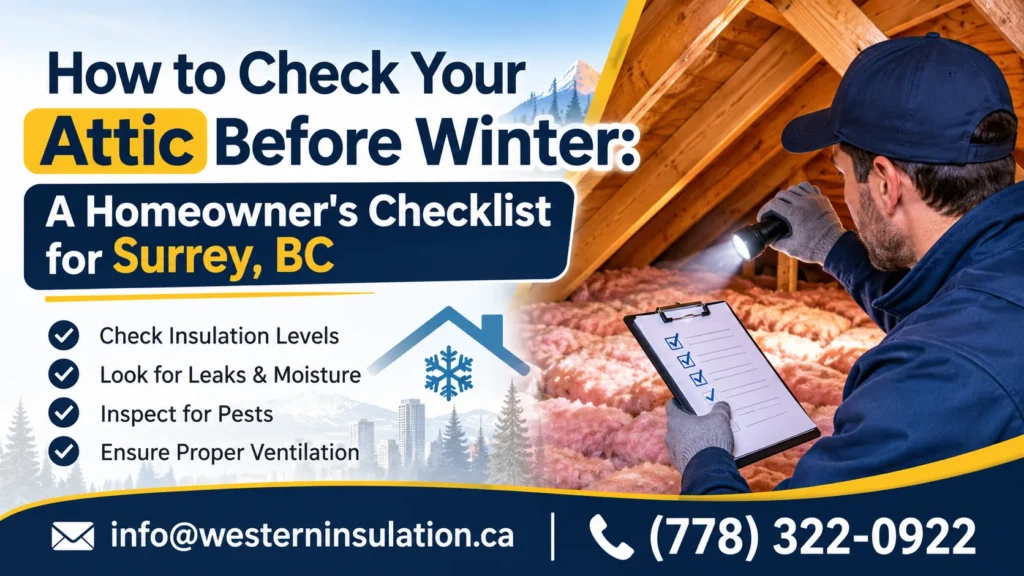
How to Check Your Attic Before Winter: A Homeowner’s Checklist for Surrey, BC
Many homeowners in Surrey, BC only check their attic when they begin to get cold in upstairs rooms, see higher heating bills, have damp issues, or inconsistent temperatures around the house.
Checking your attic before the winter can help you to spot any issues with insulation, adequate ventilation and early damp issues. As the climate in the Lower Mainland can be damp with long periods of cooler temperatures, this can be an important consideration.
If you are uncertain on the current state of your attic, follow this handy checklist to know what to look for, what issues require attention, and when to seek professional advice.
Why Should Surrey Homeowners Check Their Attics Before Winter?
If your attic isn’t adequately insulated, or has air leaks, warmer air from inside your home may be escaping from upstairs.
This can make your home less comfortable and put additional pressure on your heating system.
There are several reasons that homeowners in Surrey should ensure their attic is performing well:
Cold temperatures in certain areas of the home. Bedrooms and living rooms in the roof space may be colder than other rooms.
Increased energy use. With poor insulation more heat will escape from the house.
Damp. Warm air from inside moving into the cold attic can cause condensation.
Poor ventilation. If soffit vents are blocked, this can cause damp problems.
Old insulation. Over time insulation can lose its effectiveness, becoming squashed, displaced or damaged.
By carrying out seasonal maintenance you can spot any of these problems before they become costly to fix.
7 Things to Check in Your Attic Before Winter
1. Insulation levels
Check how much insulation is in your attic.
Over time, insulation can settle, be squashed, or may be uneven. Older properties may also have levels of insulation that no longer perform as expected.
Look for:
- Uneven insulation.
- Exposed joists.
- Gaps around the hatch.
- Uneven insulation.
- Squashed or damaged insulation.
The amount of insulation will depend upon the material used, and the R value.
For more information on what thickness of insulation is required for an R value of 50, take a look at How much attic insulation do I need for an R-value of 50?
2. Damp Issues
It is important to check for damp issues in the attic in Surrey and in the Lower Mainland.
If warm and moist air from inside the building reaches the cold attic, condensation can occur on the sheathing, nails and other surfaces.
Within your visual inspection, look out for:
- Condensation on nails.
- Frost (in colder weather).
- Staining
- Damp/matted insulation.
- Musty smells around the hatch.
If there are signs of damp in your attic, these should be addressed. Continued damp can cause damage and mould to develop.
Read more in our in-depth Guide to Attic Condensation in Winter.
3. Ensure soffit vents are working
Along with insulation, good ventilation in the attic is very important.
Soffit vents allow fresh air in from outside but with the correct extract ventilation, air can leave the attic. If insulation is too close to the eaves it can block these vents.
Look out for:
- Blocked soffit ventilation.
- Insulation blocking eaves.
- Blocked/ damaged ventilation.
- Signs of damp on roof surfaces.
Attic baffles can be installed to ensure that there is good airflow near the edges of the roof, without blocking insulation.
If there is insufficient ventilation in your attic, adding further insulation may not be sufficient to solve the problem.
4. Gaps in insulation around ceiling features
Although insulation reduces heat loss, air can still pass through.
If there are gaps in insulation around ceiling features, piping, electrics and hatches, warm air from inside the house could escape into the attic.
Within your inspection, look out for:
- Gaps around the hatch.
- Unclosed gaps in pipework.
- Gaps around electrics.
- Gaps around ceiling features.
- Discontinuity in insulation.
- Before adding additional insulation, air sealing should be considered.
To learn more on how air sealing can be beneficial in reducing draughts in BC homes over winter, check out our article.
5. Damaged/contaminated insulation
In some cases adding more insulation may not be enough to fix an issue within your attic.
Old insulation may be suffering from rodent damage, water damage, mould or contamination. In these cases it may be best to get professional advice to remove the insulation.
Look out for:
- Wet or heavily compressed insulation.
- Rodent damage.
- Odd smells.
- Droppings or nesting.
- Mould or contamination.
- If insulation seems contaminated, we do not recommend disturbing it.
Vermiculite insulation may be found in older properties and this may contain asbestos. If you suspect vermiculite do not touch, move or vacuum. Get the right professional advice for testing and then proceed with works.
Depending on the condition of the insulation, professional insulation removal and replacement may be required.
6. Inconsistent temperatures in home
Sometimes you don’t need to get into the attic to spot potential insulation issues.
Considering the temperature in your home can give you clues.
Do you get cold in upstairs rooms? Is it very warm in the top floor in summer? Are you running your heating regularly in colder weather? Or are some rooms consistently uncomfortable even with the thermostat adjusted?
Issues like this can be caused by poor insulation, air leakage, poor ventilation and issues with heating.
Read more on the 5 signs your home needs upgraded insulation to know what other signs to look out for.
7. General condition of attic
Before upgrading insulation in your attic, it can be important to understand the general condition of the attic.
A professional can assess:
- Type of insulation & R Value.
- Area covered, & depth of insulation.
- Air leakage in ceiling features.
- Condition of soffit vents & baffles.
- Damp issues & potential contamination.
- Insulation & sealing of hatch.
This can help you understand what improvements are required.
What Happens If You Ignore Attic Problems Before Winter?
If issues in your attic are left unresolved, it can cause discomfort in your home and inefficiency in energy usage.
Poor insulation can mean more heat is lost from your home. If there are holes in the insulation in the ceiling, warm, moist air can enter the attic.
If ventilation is also an issue, damp can form on cooler surfaces in the attic.
Over time this can lead to:
- More uncomfortable temperatures in upstairs rooms.
- Increased energy requirements.
- Condensation.
- Damaged/ deteriorated insulation.
- Conditions encouraging mould development.
It is typically better to address root causes of issues within the attic, rather than individual symptoms.
When Should You Consider a Professional Attic Assessment?
If your insulation is older, or you have inconsistent temperatures, visible damp issues, or signs of damage in the attic, getting a professional inspection may be useful.
An experienced insulation contractor can carry out a survey to decide if air sealing, improving ventilation, adding more insulation, or replacing insulation would be the best course of action.
In Surrey, Western Insulation can offer attic insulation services in the Lower Mainland.
An inspection can give you an idea of what level of insulation you currently have, what areas need improvement, and what is the best way to upgrade.
Frequently asked questions
How regularly should I check my attic?
We recommend you carry out a visual inspection once or twice per year. If you have had a leak in your roof, ventilation issues or suspect damp issues, we may recommend an inspection.
How do I know if I have insufficient attic insulation?
If you are getting cold in upstairs rooms, have exposed joists, uneven/insufficient insulation, or increased heating requirements, you may have insufficient insulation. A professional inspection can help you understand how much insulation you currently have.
Will adding more insulation in my attic solve condensation?
No. Condensation can occur due to air leakage, internal humidity, and poor ventilation. It is important to assess air leakage and ventilation issues before increasing insulation.
Should I remove existing insulation before adding new insulation?
Not always. If your existing insulation is clean, dry and in acceptable condition, you may be able to add additional insulation. If your insulation is wet, contaminated or in very poor condition, it may be necessary to remove and replace.
Will adding insulation to my attic make upstairs rooms more comfortable?
Yes. Correctly installed attic insulation can help to reduce heat loss in your ceiling, providing more comfortable, even temperatures in your home.
Who can check insulation in my attic in Surrey, BC?
Speak to an experienced insulation contractor in your local area to check the insulation in your attic. They can also identify air leakage and ventilation issues, and suggest suitable improvements.
Final Thoughts
It is important to consider the condition of your attic prior to colder weather. Checking insulation levels, ventilation, air leakage, and signs of damp within your attic can help you spot issues in Surrey and improve energy efficiency and comfort in your home.
Before upgrading insulation in your attic, consider a full assessment to understand what improvements are required.
Western Insulation can assist homeowners in Surrey and the Lower Mainland with attic assessments, upgrades, air sealing, and more. If you require professional assistance with your attic, take a look at our attic insulation services to find out how we can help.
Would you like us to assess your attic? Get in touch with us to speak to our team about your insulation requirements, and we can arrange an assessment.