
How Many Inches of Attic Insulation Do You Need? R-50 Depth Guide for Langley Homes
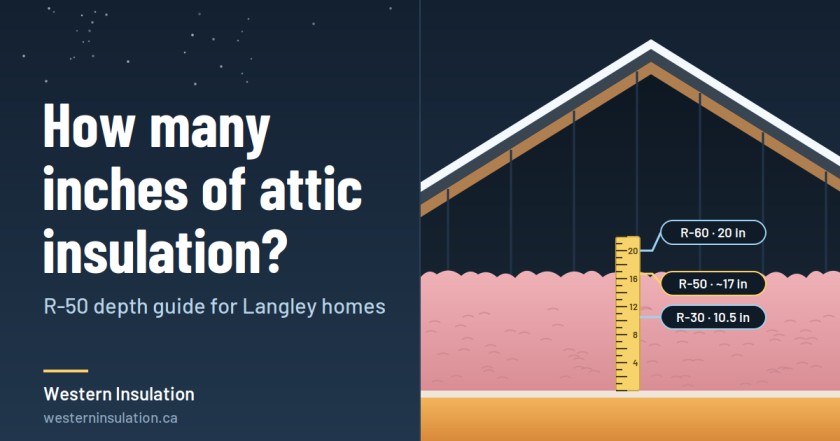
Quick answer: For a Langley or Lower Mainland attic, aim for about R-50. With blown-in fibreglass, that is roughly 16 to 18 inches of insulation, depending on the product. R-60 is about 20 inches. If you can see the tops of your ceiling joists, you likely have less than R-20 and would benefit from a top-up.
Most homeowners never measure their attic insulation. They notice cold upstairs rooms, high heating bills or frost in the attic, but have no idea how much insulation is actually up there. Checking the depth is the easiest way to find out whether your attic is doing its job.
This guide explains how many inches of insulation equal each R-value, what Langley homes need, how to measure your attic, and how depth affects your BC Hydro rebate.
Attic Insulation Depth Chart
The depth needed for each R-value depends on the material. Loose-fill fibreglass, cellulose and batts all have different R-values per inch. This chart uses Owens Corning ProPink L77 loose-fill fibreglass, a common attic product, as a reference.
| R-value | Minimum installed thickness (ProPink L77 loose-fill) | Bags per 1,000 sq ft |
|---|---|---|
| R-30 | 10.5 inches | 13.0 |
| R-38 | 13.25 inches | 16.7 |
| R-44 | 15 inches | 19.7 |
| R-49 | 16.75 inches | 22.2 |
| R-60 | 20 inches | 28.0 |
Other products differ slightly. Older or lower-grade loose-fill may need more depth for the same R-value, while dense batts may need less. Always check the coverage chart printed on the bag of the product being installed.
Quick reference for other materials
| Material | Approx. R per inch | Depth for about R-50 |
|---|---|---|
| Blown-in fibreglass | About R-2.9 to R-3.0 | About 16 to 18 inches |
| Blown-in cellulose | About R-3.2 to R-3.8 | About 14 to 16 inches |
| Fibreglass batts | About R-3 to R-4 | Several layers, often cross-laid |
| Closed-cell spray foam | About R-6 | About 8 inches (rarely used for open attics) |
What R-Value Does a Langley Attic Need?
For most Langley and Lower Mainland homes, R-50 is a sensible target for attic insulation. It balances comfort, energy savings and cost, and it’s a common recommendation for BC homes being upgraded.
Many homes built in the 1980s and 1990s in Walnut Grove, Murrayville and the City of Langley started with less, and decades of settling have reduced it further. It’s common to find attics with only R-12 to R-20 left, which is roughly 4 to 7 inches of old fibreglass.
R-60 adds a little more protection and makes sense if your attic has room and the extra cost is small. Going beyond that gives less benefit for each extra inch.
New homes follow the BC Building Code and the BC Energy Step Code, so targets for new construction are set by the designer and your municipality.
How to Measure Your Attic Insulation
You can check your attic in about five minutes:
- Open the attic hatch and look across the attic with a flashlight. Don’t walk on the insulation or between joists without proper footing.
- Find a few spots you can reach from the hatch and measure the depth with a ruler or tape measure, pushing gently to the ceiling drywall.
- Average your measurements. Insulation is often thinner near the eaves and around the hatch.
- Estimate the R-value. Multiply the depth by about 3 for fibreglass (a rough average for older loose-fill and batts).
- Look at the joists. If you can see the tops of the ceiling joists, you likely have less than R-20.
Safety note: If you see grey-brown, pebble-like insulation instead of fluffy fibres, it may be vermiculite. Don’t disturb it. Have it tested for asbestos first.
Why Depth Alone Isn’t the Whole Story
A deep layer of insulation doesn’t help much if warm air is leaking straight through it. Before adding depth, three things matter:
Air sealing
Pot lights, the attic hatch, plumbing stacks and gaps around wiring let warm, moist air into the attic. That air carries heat past the insulation and can cause frost and condensation on the roof deck. Sealing these leaks before adding insulation is essential. Our guide to air sealing your home explains where leaks usually hide.
Even coverage
Insulation needs to be the same depth everywhere. Thin spots near the eaves, around the hatch or where people have walked through the attic lower the overall performance.
Ventilation
As insulation gets deeper, it can block soffit vents. Baffles keep an air channel open between the insulation and the roof deck, so the attic can breathe. Blocked vents can lead to moisture problems, including attic condensation in winter.
How Much Insulation Do You Need to Add?
Here’s a simple way to estimate what a top-up involves:
- Measure your current depth and estimate your current R-value.
- Subtract it from your target. For example, R-50 minus R-15 means you need to add about R-35.
- Convert to depth. With blown-in fibreglass at about R-3 per inch, R-35 is roughly 12 inches of new insulation.
- Estimate the material. Contractors use the product’s coverage chart to work out the number of bags for your attic area and target R-value.
Example: a typical Walnut Grove attic
| Item | Value |
|---|---|
| Attic area | 1,000 sq ft |
| Existing insulation | About 4 inches (about R-12) |
| Target | R-50 |
| R-value to add | R-38 |
| New insulation | About 13 inches of blown-in fibreglass |
| Typical install time | One day |
Most Langley attic top-ups are completed in a single day with blown-in insulation. Learn more about blown-in insulation.
Depth and Your BC Hydro Rebate
BC Hydro and FortisBC insulation rebates are based on R-value added, not total depth. The attic rebate is calculated as:
$0.02 × R-value added × square feet, up to $900 (minimum R-12 added)
Using the example above:
- R-value added: 50 − 12 = 38
- Rebate: $0.02 × 38 × 1,000 = $760
The work must be done by a Home Performance Contractor Network (HPCN) member, and the invoice must show the starting and final R-value, the insulation type and the square footage. See the full rules on our BC insulation rebates page.
Common Depth Mistakes
- Installing too few bags. A thick-looking layer with too few bags doesn’t reach the stated R-value. The installed depth and the bag count both have to match the coverage chart.
- Uneven coverage. Deep in the middle, thin at the edges.
- Blocked soffit vents because baffles weren’t installed.
- No depth markers. Without rulers stapled to the joists, it’s hard to confirm the final depth.
- Skipping air sealing before adding depth.
- Compressing insulation by walking on it or storing boxes on top, which reduces its R-value.
Get the Right Depth the First Time
Knowing how many inches of insulation your attic needs is the first step to a warmer, more efficient home. For most Langley homes, that means about 16 to 18 inches of blown-in fibreglass for R-50, installed evenly over a sealed attic floor with clear ventilation.
Western Insulation measures existing insulation, seals air leaks, installs baffles and blows in insulation to the right depth, with depth markers so you can see the result. Learn more about our attic insulation services in Langley and the Lower Mainland.
Book a free attic insulation assessment
Frequently Asked Questions
How many inches of insulation is R-50?
With blown-in fibreglass, R-50 is roughly 16 to 18 inches, depending on the product. For example, Owens Corning ProPink L77 loose-fill reaches R-49 at a minimum of 16.75 inches. Always check the coverage chart on the bag of the product being used, since depths vary between brands.
How many inches is R-60 attic insulation?
R-60 with blown-in fibreglass is about 20 inches. Owens Corning ProPink L77 lists a minimum installed thickness of 20 inches for R-60, using about 28 bags per 1,000 square feet. Other brands and cellulose products may need slightly less or more depth.
Is R-50 enough for a Langley attic?
Yes. R-50 is a sensible target for most Langley and Lower Mainland attics, balancing comfort, energy savings and cost. Going to R-60 adds a little more benefit if the attic has room. More important than the last few inches is sealing air leaks and keeping soffit vents clear.
How do I know how much insulation I have?
Measure the depth in a few spots from the attic hatch and multiply by about 3 for fibreglass to estimate the R-value. If you can see the tops of the ceiling joists, you likely have less than R-20. A professional assessment gives a more precise reading and checks for air leaks and moisture.
Can I add new insulation over old insulation
Yes, if the old insulation is dry, clean and free of mould or rodent contamination. New blown-in insulation can be added on top to reach the target depth. Insulation that is wet, mouldy, compressed or contaminated should be removed first, and vermiculite should be tested for asbestos.
Does deeper insulation mean a bigger rebate?
The BC Hydro attic rebate is based on the R-value added, so adding more depth increases the rebate, up to a maximum of $900. For example, adding R-38 over 1,000 square feet earns about $760. The work must be done by an HPCN contractor to qualify.