attic insulation Langley BC

Insulation R-Value Guide for Langley BC Homeowners: What You Actually Need

Insulation R-Value Guide for Langley BC Homeowners: What You Actually Need If you’ve been researching insulation for your Langley home, you’ve almost certainly come across the term R-value — and you’ve probably wondered what number you actually need for your attic, your walls, your basement, or your crawlspace. The short answer is that it depends on where in your home you’re insulating. Different parts of your home lose heat in different ways and at different rates, and BC Building Code sets different minimum requirements for each one. The longer answer — and the more useful one — is what this guide covers in full. Understanding R-value before you hire a contractor or purchase materials means you can ask the right questions, evaluate quotes accurately, and make sure the job is done to the standard your Langley home actually needs. What Is R-Value and Why Does It Matter? R-value is a number that measures how well an insulation material resists the flow of heat. The higher the R-value, the more effectively that material slows heat from escaping your home in winter or entering it in summer. Think of it like a winter jacket. A thin cotton jacket might keep you comfortable on a mild day, but in a Langley February — when temperatures are damp and cold and wind is cutting across the Fraser Valley — you need something with real thickness and density. Insulation works the same way. A wall with R-12 might have been adequate when your home was built in the 1980s, but today’s BC Energy Step Code requirements and rising energy costs mean that standard no longer serves you. What makes R-value practically important for Langley homeowners is this: two homes that look identical from the outside can perform very differently depending on the R-values installed in their walls, attic, and foundation. A well-insulated home holds heat efficiently, runs its heating and cooling systems less, and keeps every room at a consistent, comfortable temperature. An under-insulated home fights a losing battle against the cold all winter — and you pay for that difference in your monthly energy bill. R-Value Requirements by Zone: What BC Building Code Requires for Langley Langley falls within BC Climate Zone 4, which covers most of Metro Vancouver and the Fraser Valley. Here is what the BC Building Code currently requires for each zone of your home — and what Western Insulation recommends to meet or exceed those standards for real-world performance. Attic Insulation: R-50 Minimum, R-60 Recommended The attic is where most Langley homes lose the most heat. Hot air rises, and without sufficient insulation in the attic floor, that warmth escapes directly through the roof. BC Building Code requires a minimum of R-40 to R-50 for attic assemblies in Climate Zone 4, but many Langley energy advisors and contractors — including our team at Western Insulation — recommend pushing to R-60 where possible. The difference between R-50 and R-60 may seem incremental on paper, but in practice it closes the gap between code compliance and genuinely high-performing thermal comfort. For most Langley attics, blown-in insulation — either ProPink fibreglass or cellulose — is the most efficient way to achieve R-50 to R-60. It covers every corner, fills irregular joist layouts, and achieves a consistent, seamless layer without gaps. If you’ve never had your attic insulation checked, it’s one of the most valuable free assessments you can book — especially in homes built before 2000, which frequently fall well below current code requirements. Exterior Walls: R-22 to R-24 Effective Exterior walls in Langley require an effective R-value of between R-22 and R-24, depending on your assembly type and local amendments. For a standard 2×6 stud wall, fibreglass or mineral wool batts in the cavity combined with a layer of continuous rigid foam on the exterior is the most common method for reaching this target without thermal bridging through the framing. What is thermal bridging? It is what happens when the wooden studs in your wall conduct heat directly to the outside, bypassing the insulation in the cavity between them. A 2×6 wall filled with R-21 batts does not actually perform at R-21 — it performs closer to R-15 due to bridging losses through the framing. Adding even a thin layer of continuous rigid foam insulation on the exterior breaks that bridge and brings the whole wall assembly up to where it needs to be. Basement Walls: R-20 Minimum Basement walls in Langley need a minimum effective R-value of R-20 under BC code. This is typically achieved with closed-cell spray foam insulation applied directly to the concrete foundation wall, or with rigid foam board panels installed against the wall and covered with a framed assembly. Spray foam is the superior choice for moisture control — it bonds directly to concrete, creates an air and vapour barrier in one step, and does not absorb water the way fibreglass does. If your basement walls are currently uninsulated or insulated with old fibreglass batts that have sagged or compressed, upgrading to a modern system delivers an immediate improvement in floor temperature, energy efficiency, and moisture control. This is covered in more depth in our crawlspace and basement insulation guide for Langley. Crawlspace Walls: R-20 Minimum Crawlspace walls follow similar code requirements to basement walls — R-20 minimum — but the moisture considerations are even more pronounced. An open, damp crawlspace in Langley is one of the most common sources of cold floors, mold growth, and energy loss in the area’s housing stock. Our basement and crawlspace insulation service addresses both the insulation and the vapour barrier, treating the crawlspace as a complete system rather than just a cavity to fill. Interior Walls: No Code Minimum, But Acoustic Matters BC Building Code does not set thermal R-value requirements for interior walls because they do not separate conditioned space from the outdoors. However, if noise control is a priority — which it increasingly is in Langley’s growing strata and multi-family market — mineral wool batt insulation in

Insulation R-Value Guide for Langley BC Homeowners: What You Actually Need Read More »
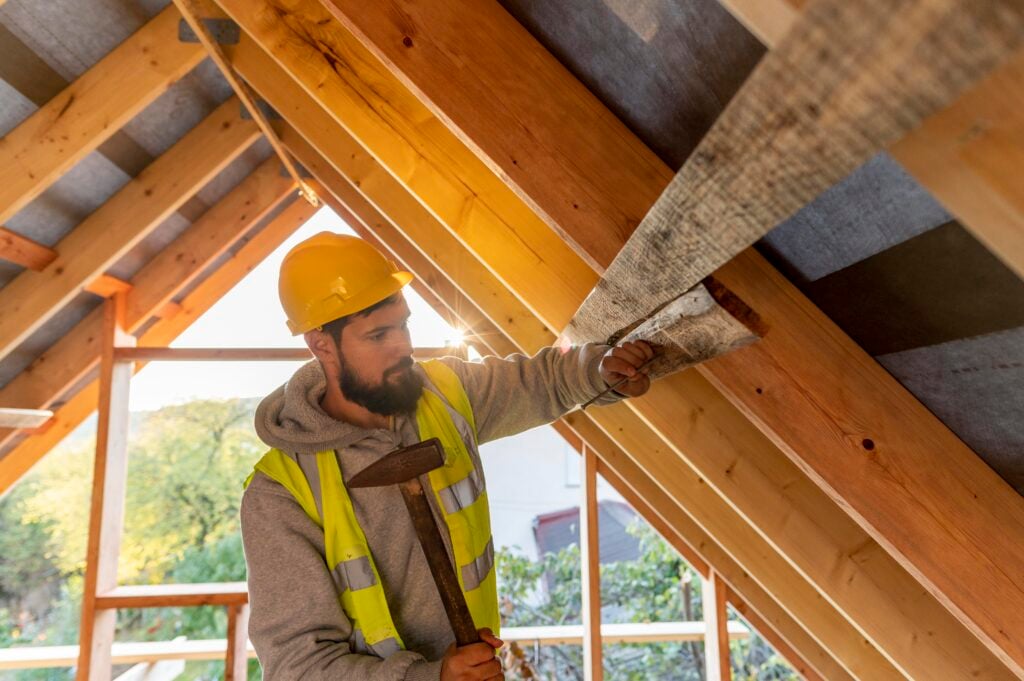
Attic insulation contractor installing insulation between roof rafters in Langley BC home

When to Replace Your Attic Insulation in Langley: Signs, Process & Costs

When to Replace Your Attic Insulation in Langley: Signs, Process & Costs Most Langley homeowners think about adding attic insulation — but far fewer think about removing the old stuff first. If your home was built before 2000, the insulation currently sitting in your attic may be doing more harm than good. It could be compressed, moisture-damaged, contaminated with mold, or simply too thin to meet today’s energy standards. Knowing when to replace (not just top up) your attic insulation is one of the most important home maintenance decisions you can make in the Fraser Valley’s damp, variable climate. In this guide, we walk you through the clear warning signs, what the removal and replacement process actually looks like, what it costs, and how to make the most of the BC rebates available to Langley homeowners. 5 Signs Your Langley Attic Insulation Needs to Be Replaced (Not Just Topped Up) Adding new insulation on top of old, damaged material is a common mistake. Here’s when a full removal and replacement is the right call: 1. You Can See Moisture, Staining, or Mold Langley’s wet winters push moisture into attic spaces. Once insulation gets wet, it loses its R-value immediately and becomes a breeding ground for mold. Wet batt insulation in particular clumps and sags, leaving gaps where heat escapes freely. If you spot dark staining, musty odours, or visible mold, a professional insulation removal is essential before any new material goes in. 2. Your Home Has Vermiculite or Old Fibreglass Batts Homes built before the 1990s may contain vermiculite insulation, which can be associated with asbestos contamination. Even if it isn’t vermiculite, old fibreglass batts from the 1980s and 90s have often settled to a fraction of their original depth and no longer provide meaningful resistance. Topping up over degraded material gives you a false sense of security without the performance. 3. You’ve Had a Rodent or Pest Problem Mice, squirrels, and other pests frequently nest in attic insulation, contaminating it with droppings and urine. No amount of new insulation fixes a hygiene problem underneath. Full vacuum removal is the only solution, and it protects your family’s air quality long term. 4. Your Energy Bills Keep Climbing If your heating and cooling costs are rising year over year despite no change in usage habits, your attic is likely the culprit. As we’ve covered in our complete guide to attic insulation in Langley, a well-insulated attic can cut energy costs by 20–30%. When old insulation is the barrier to those savings, replacement — not addition — unlocks the full benefit. 5. You’re Planning a Major Renovation If you’re re-roofing, adding HVAC equipment, or converting attic space, it makes sense to start fresh with new, properly installed insulation rather than working around deteriorated existing material. What Does the Attic Insulation Removal Process Look Like? Many homeowners are surprised to learn that professional attic insulation removal is a clean, fast, and minimally disruptive process when done properly. Here’s what to expect when you book a removal and replacement with Western Insulation in Langley: Step 1 – Attic Inspection Our team inspects your attic to assess insulation condition, identify any moisture damage, pest evidence, or air sealing issues, and determine the best removal approach for your home’s layout. Step 2 – Vacuum Removal We use industrial-grade insulation vacuum equipment to remove all existing material safely. The insulation is bagged and disposed of properly off-site. This step also gives us access to the attic floor to seal any bypasses — the small gaps around wires, pipes, and fixtures that allow conditioned air to escape regardless of how much insulation sits above them. Step 3 – Air Sealing This is where significant energy savings are actually won. Before any new insulation goes in, our installers seal all attic bypasses with spray foam or caulking. This step is often skipped by less experienced contractors, but it makes a measurable difference to your home’s thermal performance. Step 4 – New Insulation Installation Depending on your home and goals, we install the most appropriate material — commonly blown-in insulation such as ProPink® cellulose or fibreglass, which covers irregular spaces evenly and achieves the high R-values required by BC building code. For certain applications, batt insulation or rigid foam boards may also be part of the solution. Step 5 – Final Check and Documentation We verify R-value coverage, confirm ventilation is unobstructed, and provide documentation for your records — including what you need for rebate applications. How Much Does Attic Insulation Removal and Replacement Cost in Langley? Costs vary based on attic size, insulation type, and condition of the existing material. As a general guide: The good news? Current BC Hydro and FortisBC programs mean eligible Langley homeowners can access up to $5,500 in rebates on qualifying insulation upgrades. Our team handles all the paperwork — you don’t need to navigate the program requirements on your own. Learn more on our rebates page. Blown-In vs. Batt: Which Is Better for Langley Attic Replacement? After removal, most Langley homes benefit most from blown-in insulation — either cellulose or fibreglass. Blown-in material fills every corner and gap without cutting or fitting around obstructions, making it ideal for the irregular joist layouts common in older Fraser Valley homes. It also achieves higher R-values per inch and settles less over time than older batt products. That said, every attic is different. Our home insulation team in Langley will assess your specific attic and recommend the right product for your goals and budget — not just the easiest option to install. Why Work With a Local Langley Insulation Contractor? Not all insulation companies understand the specific challenges of Langley’s climate — the persistent winter humidity, the temperature swings between seasons, and the ventilation requirements that prevent moisture buildup in a tightly sealed attic. Local experience matters. At Western Insulation, we’ve worked on hundreds of homes across Langley and the Fraser Valley. We understand local building codes, we’re familiar with the home styles and construction

When to Replace Your Attic Insulation in Langley: Signs, Process & Costs Read More »

bc-hydro.png
clean-bc.png
fortis-bc.png
Get Rebates On Your Insulation