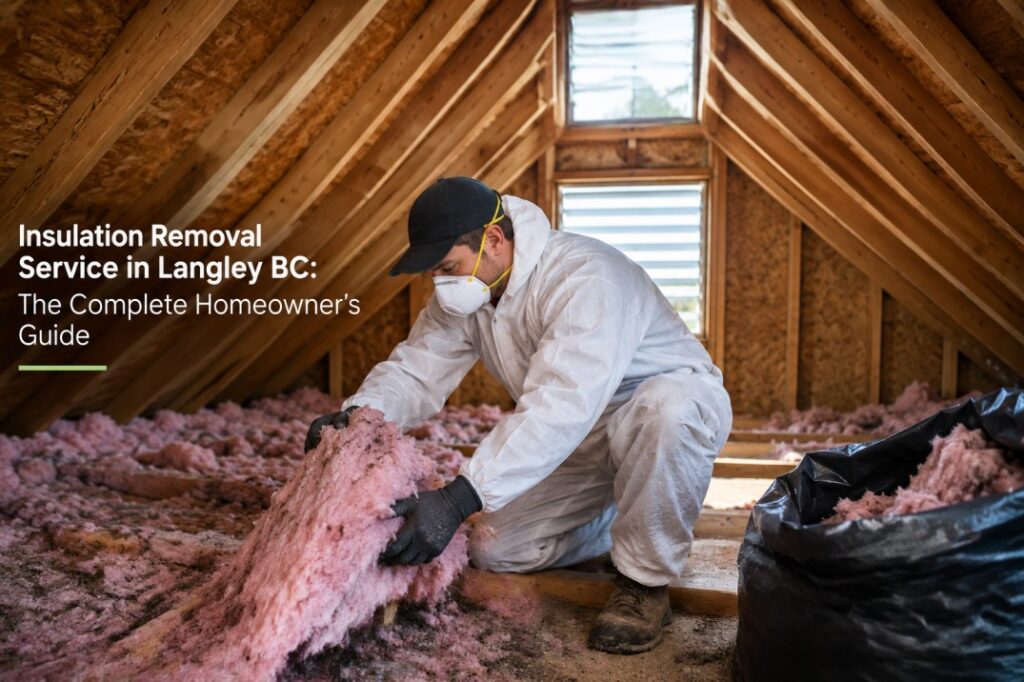
Insulation Removal Service in Langley BC: The Complete Homeowner’s Guide
Insulation Removal Service in Langley BC: The Complete Homeowner’s Guide The short answer: Attic or crawlspace insulation in Langley BC needs to be professionally removed when it is mold-contaminated, pest-damaged, contains vermiculite that may include asbestos, or has degraded so significantly that adding new material on top would not deliver the performance improvement you are paying for. Adding new insulation over compromised existing material is the most common and costly mistake Langley homeowners make — and it always costs more to fix later than it would have to remove and start correctly the first time. Most Langley homeowners only think about insulation when they are adding it — not when they need to take it out first. But professional insulation removal is the foundational step in a significant proportion of Fraser Valley insulation upgrade projects, and getting the sequence wrong — topping up or adding over compromised material — is what turns a well-intentioned energy upgrade into a project that fails to deliver and eventually requires remediation at a higher cost. This guide explains when removal is required, what the process looks like, what it costs in Langley BC, and how to make sure the project is done correctly from start to finish. When Does Insulation Need to Be Removed in Langley BC? Not every Langley home needs its insulation removed before an upgrade. Understanding the specific conditions that make removal necessary — rather than a top-up — is the first step in any insulation assessment. Mold-Contaminated Insulation This is the most common reason for insulation removal in Langley BC homes — and the most important one to address correctly. In BC’s persistently damp climate, attics and crawlspaces that have had moisture infiltration create the conditions for mold to establish itself in the insulation material. Mold-contaminated insulation continues to develop and spread in the enclosed environment beneath new insulation if it is simply covered over rather than removed. The correct sequence is removal first, followed by inspection and where necessary treatment of affected structural surfaces, followed by thorough air sealing of the bypass locations that allowed warm moist air to reach cold surfaces, and then installation of new blown-in insulation to the target R-value. The full relationship between insulation and mold in Langley BC homes is covered in our insulation and mold prevention guide. Signs of mold-contaminated attic insulation include: visible dark staining on the underside of roof sheathing, a persistent musty odour that worsens in warm weather, and insulation material that appears clumped, discoloured, or has an unusual texture compared to its original state. Pest-Contaminated Insulation Rodents and squirrels are endemic to the Fraser Valley, and attic insulation is a favoured nesting material. Once pests have established themselves in an attic, the insulation they have nested in and contaminated with droppings and urine cannot be safely topped up or built over. It presents a genuine health risk — rodent droppings in insulation release airborne particulates that affect indoor air quality daily — and a hygiene problem that no amount of new material placed above it resolves. Professional removal using industrial vacuum equipment safely extracts all contaminated material, the attic is then inspected and cleaned, and new insulation is installed over a space that has been properly addressed. Our insulation removal service covers pest-contaminated attics regularly across Langley and the Fraser Valley. Vermiculite Insulation Vermiculite is a grey, pebble-like granular insulation material that was widely used in Canadian attics from the 1950s through the early 1990s. It is identifiable by its colour — grey to silver-grey — and its lightweight, expanded granular texture that looks unlike modern fibreglass or cellulose blown-in material. Some vermiculite insulation — particularly products sourced from the Libby, Montana mine that supplied a large proportion of North American vermiculite until 1990 — may be contaminated with naturally occurring asbestos. This is a critical consideration for Langley homeowners with pre-1990 homes. WorkSafeBC regulations in British Columbia treat vermiculite insulation as presumptively asbestos-containing unless laboratory testing demonstrates otherwise. This means it cannot be disturbed without following specific handling protocols, and the decision to remove it — or to encapsulate and insulate over it without disturbance — must be made in consultation with a contractor who understands the regulatory requirements and the specific conditions of the attic in question. If your pre-1990 Langley home has never had its attic insulation professionally identified, and you suspect it may contain vermiculite, a professional inspection before any work proceeds is essential. Western Insulation inspects every attic before recommending a scope and identifies any material concerns before committing to an approach. Significantly Degraded Insulation Old fibreglass batt insulation that has settled, compressed, or absorbed moisture over decades of service delivers a fraction of its original rated R-value. A 1970s Langley attic with original fibreglass batts rated at R-12 at installation may be performing at effective R-5 or lower after 50 years of settling, compression, and moisture exposure. In cases where existing insulation has degraded to a point where adding new blown-in material on top produces only a marginal real-world improvement, removal and fresh installation on a clean substrate delivers significantly better performance at comparable or lower total cost. The best insulation guide for older Langley homes covers how to assess the condition of your specific home’s insulation by construction era. What Does Professional Insulation Removal Actually Involve in Langley? Professional insulation removal in Langley BC is cleaner, faster, and less disruptive than most homeowners expect when they first consider it. Here is what a properly executed removal project looks like from start to finish. Step 1 — Professional Inspection Before any material is extracted, a trained inspector assesses the attic or crawlspace. This covers: the type and condition of existing insulation, the presence of any moisture staining, mold evidence, pest activity, or suspect materials like vermiculite, the structural condition of the attic floor and sheathing, and the air bypass locations that will need to be sealed before new insulation is installed. This step determines the correct removal approach and identifies whether any
Insulation Removal Service in Langley BC: The Complete Homeowner’s Guide Read More »